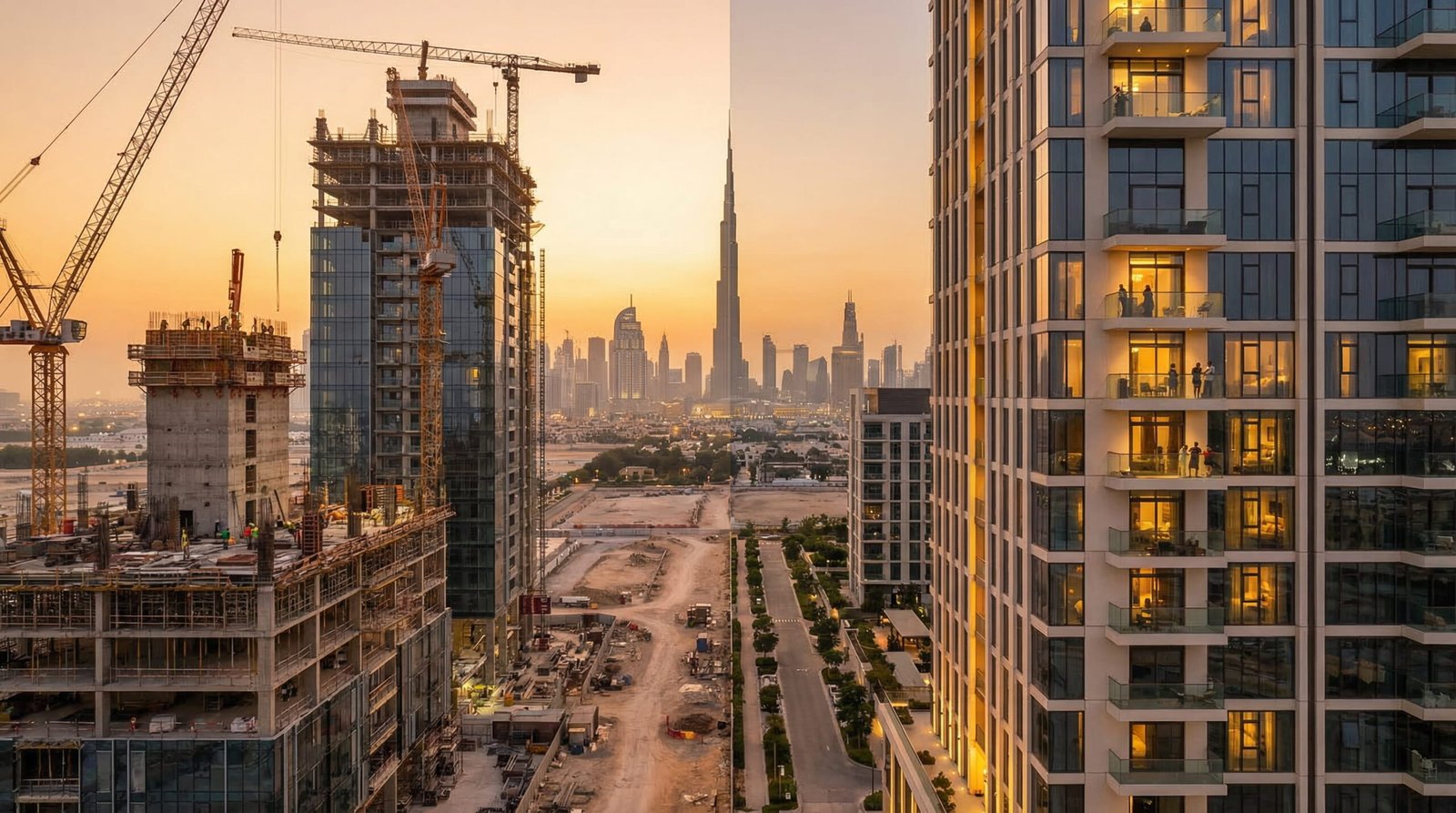
In 2025, Dubai recorded over 270,000 property transactions worth AED 917 billion — a 20% year-on-year increase. Of those, roughly 70% were off-plan purchases. That means seven out of every ten buyers chose to put their money into a property that hadn’t been built yet.
On the surface, this looks like a clear verdict: off-plan wins. But the 2026 market is entering a different phase. Approximately 55,000 residential units are expected to be delivered this year, with another 75,000 in 2027 — and the vast majority are apartments in a handful of specific areas. The supply wave is real, it’s concentrated, and it changes the off-plan vs ready equation in ways that generic advice from 2023 simply doesn’t account for.
This isn’t a “which one is better” article. The honest answer is: it depends on your money, your timeline, your risk tolerance, and critically, where you buy. This guide gives you the actual data and frameworks to make that decision for yourself.
The 2026 Numbers You Need Before Deciding Anything
Before we compare the two, let’s establish the market context that defines everything else:
| Market Metric | 2025/2026 Data |
| Total residential transactions (2025) | 270,000+ (AED 917 billion) |
| Off-plan share of transactions | ~70% (139,077 deals) |
| Ready property share | ~30% (higher avg price: AED 2.87M vs AED 2.61M) |
| Units expected to deliver in 2026 | ~55,000 (but only 48% may complete on time) |
| Units expected to deliver in 2027 | ~70,000–75,000 |
| Pipeline composition | 86% apartments, 14% villas/townhouses |
| Top 5 delivery areas (45% of pipeline) | JVC/JVT, Dubai South, MBR City, Business Bay, Dubailand |
| Unit type in pipeline | 66% studios and 1-bedrooms |
| Population growth (2025) | 208,000 new residents (5.2% increase) |
| Cash buyers (of total transactions) | 86% (Knight Frank estimate) |
| Projected GDP growth (UAE, 2026) | 5.0% (IMF) — fastest in GCC |
The critical insight: The supply wave is NOT evenly distributed. It’s concentrated in specific unit types (studios/1-beds) in specific areas (JVC, Business Bay, Dubai South). This means off-plan in those segments carries very different risk than off-plan in undersupplied segments like villas or waterfront.
Off-Plan vs Ready: The Head-to-Head Comparison
| Factor | Off-Plan | Ready |
| Entry Price | 10–30% below equivalent ready units | Market price — no discount |
| Payment Structure | 60/40, 70/30, or post-handover plans | Full price or mortgage at purchase |
| Capital Appreciation | 20–40% by handover (in recent cycle) | 8–12% annual (Cushman & Wakefield 2026) |
| Rental Income | Zero until handover (2–4 years) | Immediate — from day one |
| Mortgage Access | Limited until near completion | Full access (up to 80% LTV for residents) |
| Buyer Protection | RERA escrow accounts, developer regulation | Title deed, what-you-see-is-what-you-get |
| Construction Risk | Delays possible (48% completion rate in 2026) | None — property exists |
| Customisation | Layout choices, finishes (varies by developer) | Limited to renovation after purchase |
| Supply Risk (2026) | HIGH in JVC, Business Bay, Dubai South studios | LOW in established communities with limited stock |
| Golden Visa Eligible | Yes (AED 2M+, with Oqood registration) | Yes (AED 2M+, immediate Title Deed) |
| Best For | Long-term investors, budget-conscious buyers | End-users, income-focused investors |
The Case for Off-Plan in 2026: When It Works
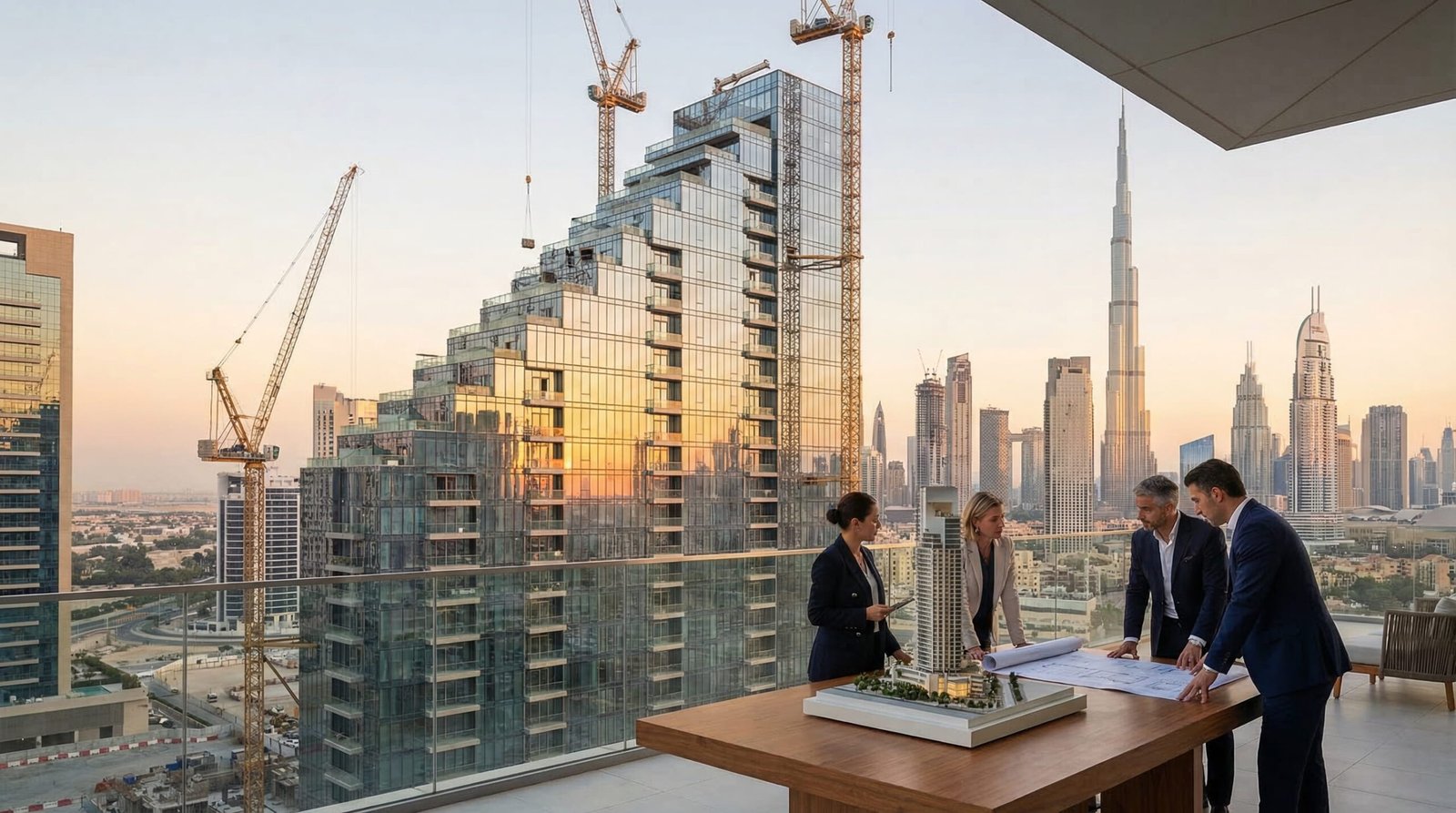
Off-plan’s dominance isn’t accidental. The financial mechanics are compelling for the right buyer. Here’s why 70% of the market still chooses it:
1. The Payment Plan Advantage
Most developers now offer structured payment plans that dramatically reduce upfront capital requirements. A typical 60/40 plan means you pay 60% during construction (spread across milestones over 2–3 years) and 40% at handover. Some developers offer even more aggressive 80/20 or post-handover plans stretching payments 3–5 years beyond completion.
On a AED 2 million off-plan apartment with a 60/40 plan, your initial commitment might be as low as AED 200,000–400,000 (10–20% down), with the remainder paid in instalments. Compare this to a ready property where you need 20–25% down payment plus 7–10% in closing costs upfront — that’s AED 540,000–700,000 in cash on day one.
2. The Capital Appreciation Window
Off-plan properties in Dubai’s recent growth cycle have delivered 20–40% capital appreciation between launch and handover. This means a property purchased at AED 1.5 million off-plan might be worth AED 1.8–2.1 million by the time construction completes. Off-plan villa prices in some communities like Dubai Hills Estate have risen approximately 59% in three years.
This appreciation happens without you having paid the full purchase price — creating leveraged returns that are impossible to replicate with a ready purchase. If you’ve paid AED 600,000 toward a AED 1.5M property that’s now worth AED 2M, your gain of AED 500,000 represents an 83% return on capital deployed.
3. RERA Escrow Protection
Dubai has one of the strongest off-plan buyer protection frameworks globally. RERA mandates that all off-plan payments go into escrow accounts — developers cannot access these funds until construction milestones are independently verified. If a project is cancelled, buyers are entitled to refunds from the escrow. Developers must also register projects with RERA and obtain approvals before they can sell a single unit.
This is why you hear the horror stories from other markets but rarely from Dubai. The regulatory infrastructure is genuinely strong, provided you’re buying from a RERA-registered project.
4. When Off-Plan Makes the Most Money
- Buying from established developers (Emaar, Nakheel, Sobha, Majid Al Futtaim) in undersupplied segments like villas, waterfront, or communities with limited inventory
- Getting in at launch pricing before construction begins, when the discount to ready-market values is widest (15–30%)
- Choosing locations with strong infrastructure investment (Metro Blue Line corridor, Expo City, Dubai Creek Harbour) where appreciation is driven by real development, not speculation
Holding through to handover and beyond — the best off-plan returns come to investors with 3–7 year horizons, not flippers
The Case for Ready Property in 2026: When It Wins
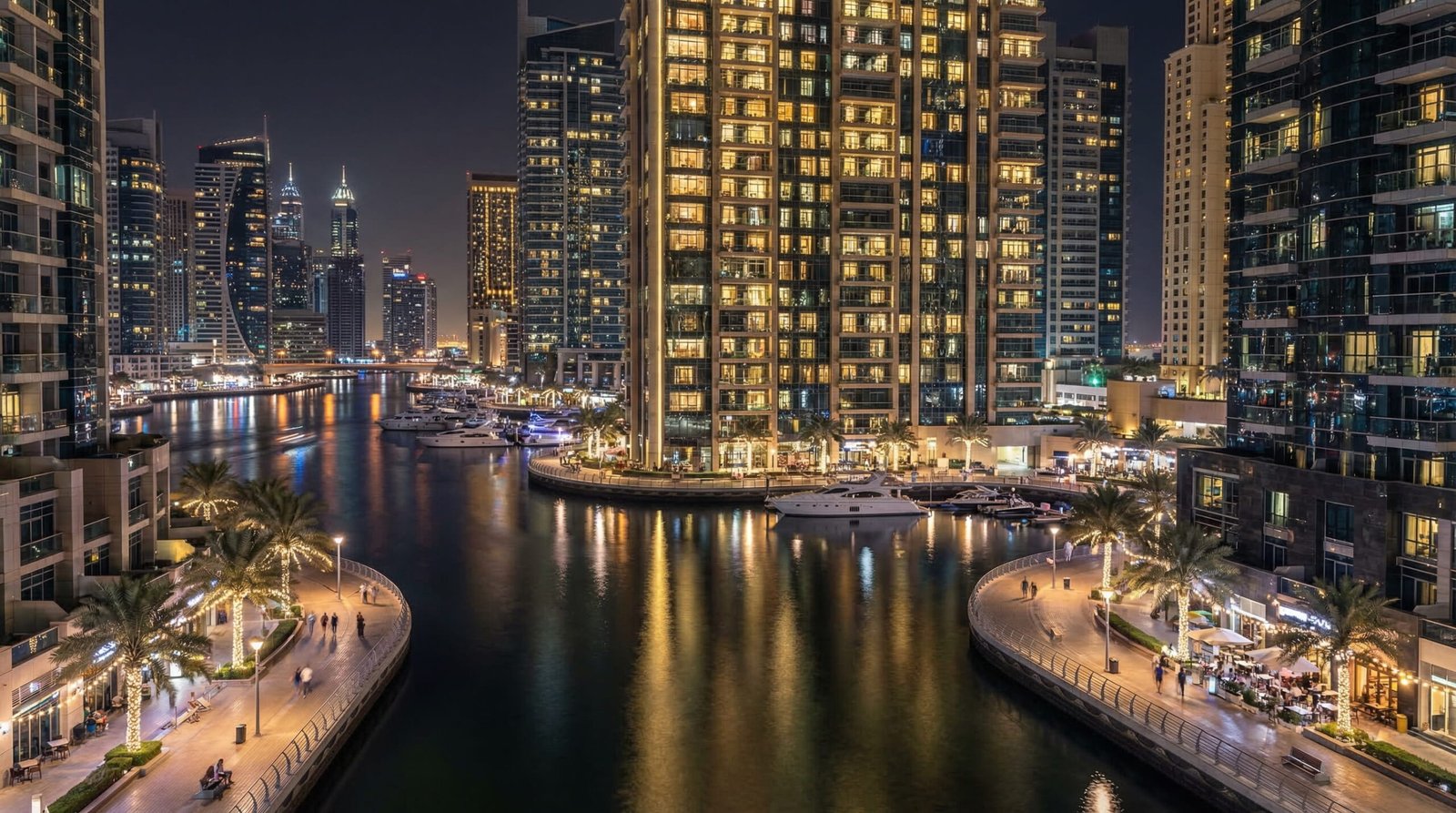
Ready properties account for “only” 30% of transactions — but they command higher average prices (AED 2.87 million vs AED 2.61 million for off-plan), and the investors buying them tend to be more experienced. Here’s why:
1. Immediate Rental Income
A ready property starts generating rental income from the day you take the keys. Average gross rental yields in Dubai range from 5–7% citywide, with pockets in JVC and Arjan reaching 8–9% and premium locations like Palm Jumeirah and Downtown offering 4–6%. Over a 3-year period while an off-plan property sits under construction, a ready property generating AED 100,000–150,000 per year in rent accumulates AED 300,000–450,000 in income.
This rental income isn’t just profit — it covers mortgage payments, service charges, and provides a cash flow buffer against market fluctuations. Off-plan investors have zero income during the construction period, which means they’re net negative on cash flow until handover.
2. Zero Construction Risk
The headline statistic that most off-plan articles ignore: of the approximately 71,600 units forecast for delivery in 2026, only about 48% are expected to complete on time. That means roughly half of all off-plan buyers expecting their property this year will face delays. Historically, between 2022 and 2024, only 97,000 out of 174,000 forecast units were actually delivered — a 56% completion rate.
Delays aren’t just inconvenient — they cost money. Extended construction means extended payment plans, delayed rental income, and in some cases, market conditions that shift unfavourably by the time the unit is actually ready.
3. Full Mortgage Access
Banks offer up to 80% loan-to-value (LTV) for UAE residents on ready properties, and up to 75% for non-residents. Off-plan properties have limited mortgage options until the project is near completion or the developer has a specific arrangement with banks. This means ready property buyers can leverage their capital more effectively through financing, while off-plan buyers are largely reliant on cash or developer payment plans.
4. When Ready Makes the Most Money
- Buying in established communities with limited new supply (Dubai Marina, Palm Jumeirah, Emirates Hills, Dubai Hills villa zones) where values are supported by genuine scarcity
- Purchasing during correction windows (analysts project potential softening in Q3–Q4 2026 in oversupplied areas) when motivated sellers offer discounts on completed units
- Targeting family-oriented properties (3+ bedroom apartments, townhouses, villas near schools) where demand consistently outpaces supply
Generating immediate cash flow to service a mortgage or fund other investments — the time value of money matters.
The 2026 Supply Wave: The Factor That Changes Everything
This is the section that most “off-plan vs ready” articles skip. And it’s arguably the most important factor for 2026 specifically. Between 2026 and 2030, over 400,000 residential units are under construction or announced for delivery. Even accounting for Dubai’s historical pattern of delays (only 48–56% of units complete on schedule), the volume of new homes entering the market over the next 2–3 years is unprecedented.
Where the Supply Is Concentrated
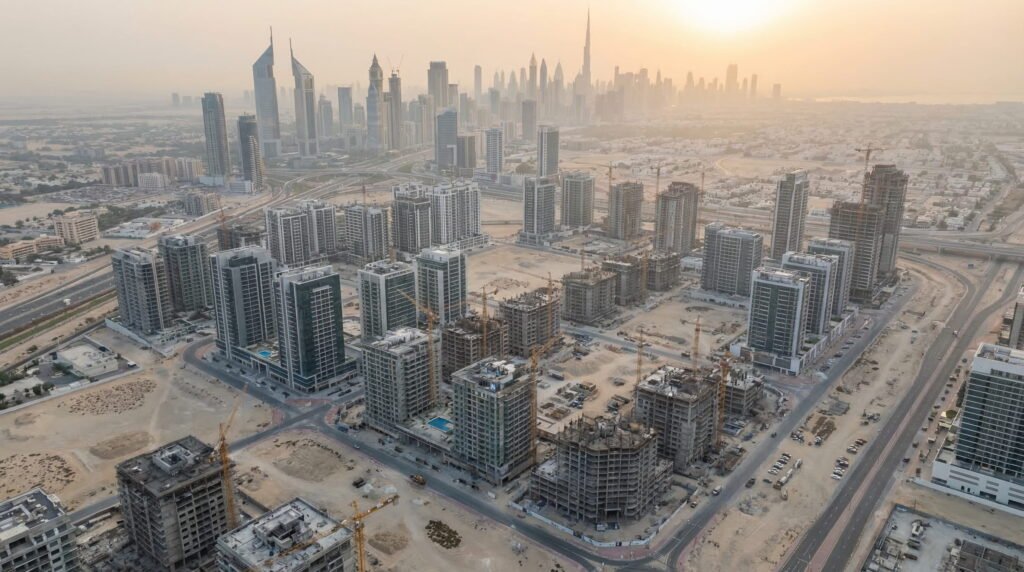
The pipeline is not spread evenly across Dubai. Nearly 45% of all under-construction stock is located in just five districts:
| Area | Units (2025–2027) | Dominant Type | Risk Level |
| JVC / JVT | ~16,850 | Studios & 1-beds | HIGH |
| Business Bay | ~10,100 | Studios & 1-beds | HIGH |
| Dubai South / DIP | Large pipeline | Entry-level apartments | HIGH |
| MBR City | Significant | Mixed apartments | MEDIUM-HIGH |
| Dubailand / Arjan | Growing | Studios & 1-beds | MEDIUM-HIGH |
| Dubai Hills (villas) | Limited | Villas/Townhouses | LOW |
| Palm Jumeirah | Very limited | Luxury apartments/villas | LOW |
| Arabian Ranches | Moderate (Phase 3) | Villas/Townhouses | LOW |
| Dubai Marina / JBR | Very limited | Waterfront apartments | LOW |
What This Means for Off-Plan Buyers
If you’re buying off-plan in a high-supply area (JVC studios, Business Bay one-beds, Dubai South apartments), your property will be competing with thousands of similar units at handover. This creates downward pressure on both resale values and rental rates. Some analysts project price corrections of 10–15% in the most oversupplied segments.
If you’re buying off-plan in a low-supply segment (villas, waterfront, luxury branded residences, large family apartments), the supply wave barely touches you. Villa and townhouse inventory accounts for only 14% of the pipeline, while demand from families continues to surge. This is where off-plan still works exceptionally well.
What This Means for Ready Property Buyers
Ready properties in established communities with limited new inventory (Marina, Palm, Emirates Hills, Dubai Hills villas, JBR) are structurally protected from the supply wave. Their values are supported by genuine scarcity, established amenities, and steady rental demand. In contrast, ready properties in high-supply areas may face pressure as new, modern units with developer payment plans compete for the same tenants and buyers.
The 2026 playbook: Off-plan wins in undersupplied segments. Ready wins in oversupplied segments where you can buy at correction pricing and earn immediate rental income. The worst position? Buying off-plan in an oversupplied area at inflated launch prices, then facing a market with 10,000 similar units at handover.
The Decision Framework: Which One Is Right for You?
Choose Off-Plan If:
- You have limited upfront capital (under AED 500,000) and need flexible payment plans to enter the market
- Your investment horizon is 5+ years and you can wait 2–4 years for construction without needing rental income
- You’re targeting undersupplied segments (villas, townhouses, waterfront, branded residences) where supply constraints support long-term appreciation
- You want to buy from a top-tier developer (Emaar, Sobha, Nakheel, Majid Al Futtaim) with a proven delivery record and strong resale market
- You’re comfortable with construction risk and understand that delays are statistically likely (only ~50% of units deliver on schedule)
Choose Ready If:
- You need rental income immediately to service a mortgage, generate cash flow, or justify the investment from Year 1
- You’re an end-user who needs to move in (for school year, job relocation, family reasons)
- You want to buy in an oversupplied area at a discount — the 2026 handover wave may create buying opportunities in JVC, Business Bay, and Dubai South for patient cash buyers
- You prefer full mortgage access (up to 80% LTV for residents) to maximise leverage on your capital
- You want certainty — you can inspect the property, verify the quality, check the view, and know exactly what your service charges will be before committing
Avoid These Common Mistakes
1. Buying off-plan in a high-supply area because of an attractive payment plan. The payment plan is the bait. The question is: will 5,000+ similar units competing with yours at handover make it worth it?
2. Ignoring the developer’s track record. Not all developers are equal. Check DLD’s project registration, the developer’s delivery history, and whether previous projects were completed on time and to specification. Established names like Emaar, Sobha, and Nakheel have delivery rates far above the market average.
3. Comparing off-plan launch price to ready market price without adjusting for time. A property that’s 20% cheaper but takes 3 years to deliver isn’t necessarily a better deal than a ready property that earns rent for those 3 years.
4. Forgetting about service charges at handover. Off-plan buyers often face unexpected service charge bills when the building completes. These can be AED 15–25 per sq ft in newer apartment buildings, adding AED 15,000–25,000+ annually to your costs from day one.5. Buying ready in an area about to be flooded with new supply. A ready property in a location where 5,000 new units are delivering in the next 12 months may face downward pressure on both rent and resale value. Check the handover schedule for your specific community.
Frequently Asked Questions
Is off-plan safe in Dubai?
Yes, with qualifications. RERA’s escrow account system protects buyer funds, and developer regulation is strong. However, project delays are common (only ~50% complete on schedule), and not all developers have equal track records. Stick to RERA-registered projects from established developers, and the risk is manageable.
What is the average off-plan discount vs ready?
Off-plan properties are typically priced 10–30% below equivalent ready units in the same area. The discount is widest at launch and narrows as construction progresses. By the time a project is 70–80% complete, the price gap may be only 5–10%.
Can I get a mortgage on off-plan property?
Mortgage options for off-plan are limited until the project is near completion. Most buyers use developer payment plans during construction, then arrange a mortgage at or after handover. Some banks offer pre-approval for off-plan purchases from select developers, but the loan is disbursed only upon completion.
Where does off-plan still work best in 2026?
Villas and townhouses (only 14% of the pipeline), waterfront communities, branded residences, and projects in undersupplied areas like Dubai Hills Estate villas, Palm Jebel Ali, Tilal Al Ghaf, and Dubai Creek Harbour. These segments have structural supply constraints that protect off-plan appreciation.
Does off-plan qualify for the Golden Visa?
Yes. Off-plan properties worth AED 2 million or more from DLD-approved developers qualify for the 10-year Golden Visa. You’ll need the registered Oqood certificate and proof that the total investment meets the threshold. Ready properties qualify immediately upon Title Deed issuance.
Should I flip off-plan before handover or hold?
In the current 2026 market, holding is generally smarter than flipping. The days of easy pre-handover flips are fading — resale activity in the off-plan segment is slowing, and buyers are becoming more selective. Investors who hold through to handover and rent benefit from both appreciation and income. Flippers face a market where the buyer pool has more options than ever.
The Bottom Line
The off-plan vs ready debate doesn’t have a universal winner. What it has is a clear framework: off-plan works when you’re buying in undersupplied segments from proven developers with a multi-year horizon and can tolerate construction delays. Ready works when you need income now, want certainty, or are buying into an oversupplied area where completed units at correction pricing offer better risk-adjusted returns than new launches.
The trap is treating all off-plan as equal. A villa from Emaar in an undersupplied community and a studio from an unknown developer in an area receiving 10,000+ new units are both technically “off-plan” — but they’re fundamentally different investments with different risk profiles and return expectations.
In 2026, the investors who win are the ones who look past the label and examine the specifics: which developer, which area, which unit type, how much supply is coming, and what the realistic timeline looks like. The data is available. Use it.