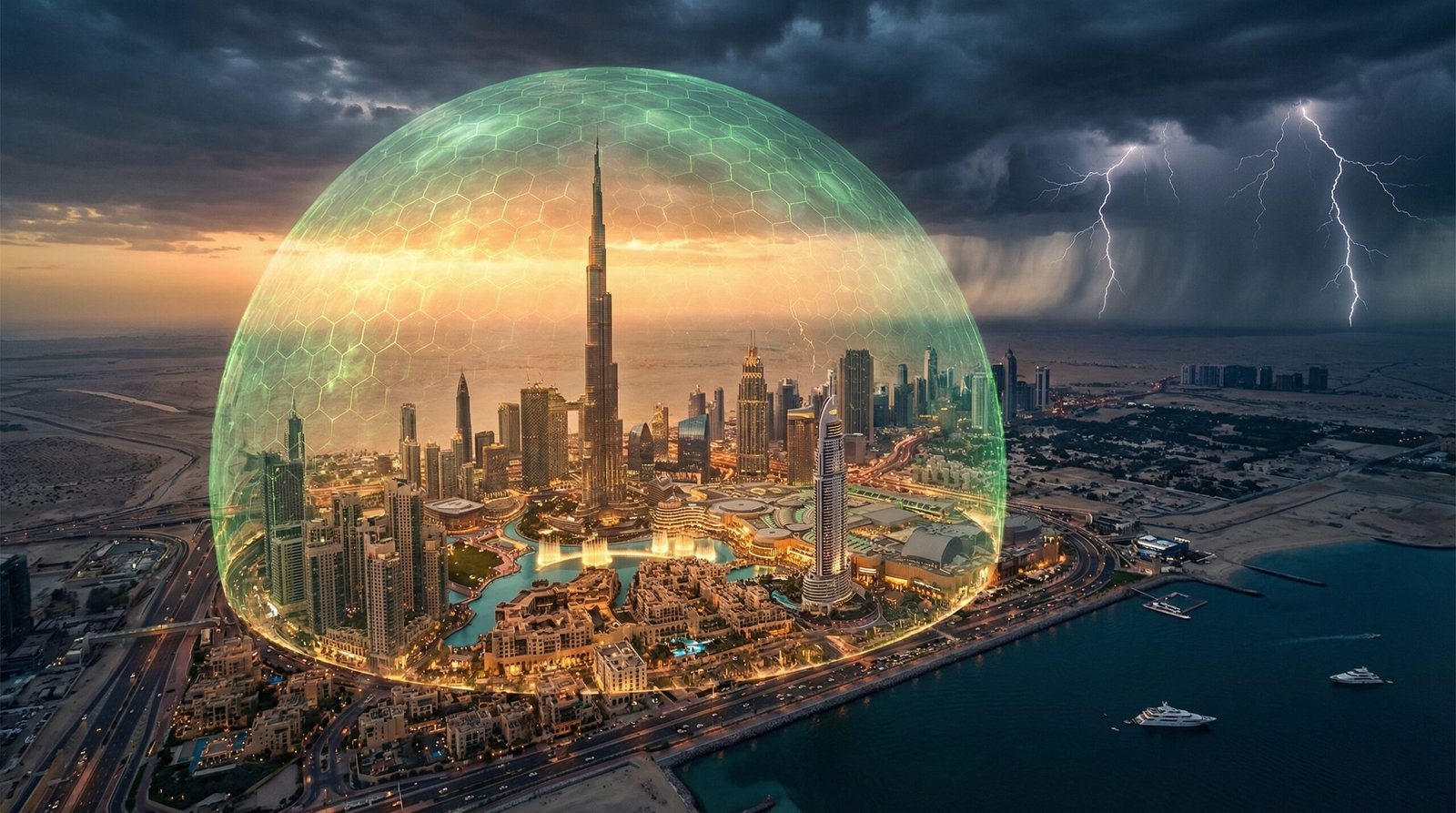
Dubai’s biggest developers are sitting on a financial fortress most buyers know nothing about. Here’s the balance sheet behind your apartment.
When a regional crisis hits, every headline screams the same thing: “Dubai property market at risk.” The stock index drops. Social media fills with panic. People start comparing this to 2008.
But here’s something almost nobody talks about: the four biggest developers in Dubai are collectively holding over $10 billion in cash reserves — and that’s before you count the $17+ billion locked in escrow accounts for ongoing construction.
This isn’t optimism. It’s arithmetic. Let’s look at what S&P Global Ratings — the agency that actually rates these companies’ debt — found when they opened the books.
A cash fortress hiding in plain sight
S&P rates four Dubai developers: Emaar, Damac, PNC Investments (Sobha Realty), and Omniyat. Their combined financial position as of December 2025:
| $28B+ Total cash + escrow across 4 developers | 2–3 yr Revenue already locked in through pre sales | $0 New funding needed in 2026 |
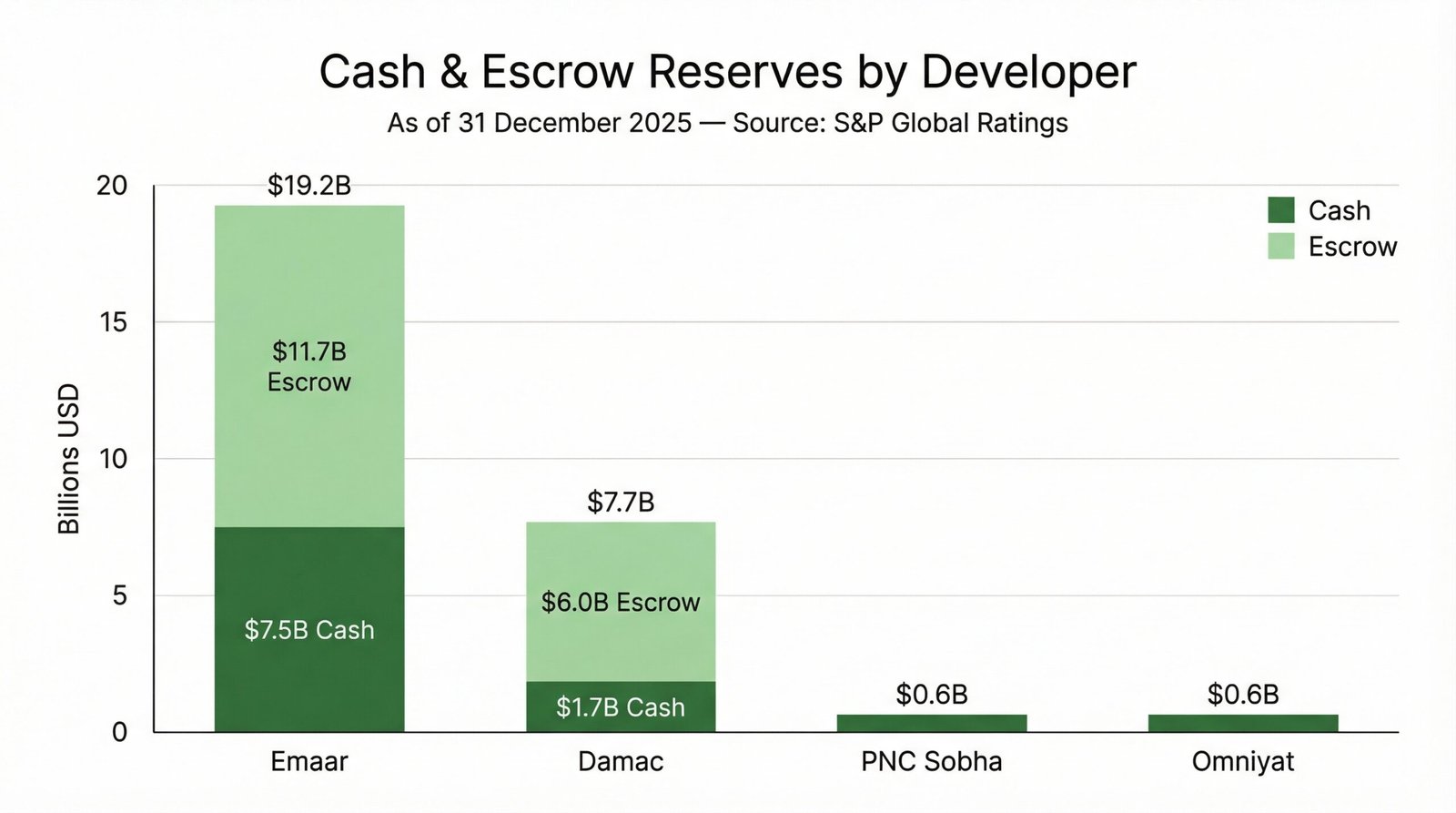
Emaar alone holds $19.2 billion in combined cash and escrow. To put that in perspective: that’s larger than the entire GDP of Iceland ($18.5B).
Years of work already paid for
Revenue backlogs represent sales that have already been made but not yet recognized as revenue — homes sold off-plan where construction is ongoing. Even if no new sale happens for the next two to three years, these developers can keep operating on commitments already in place.
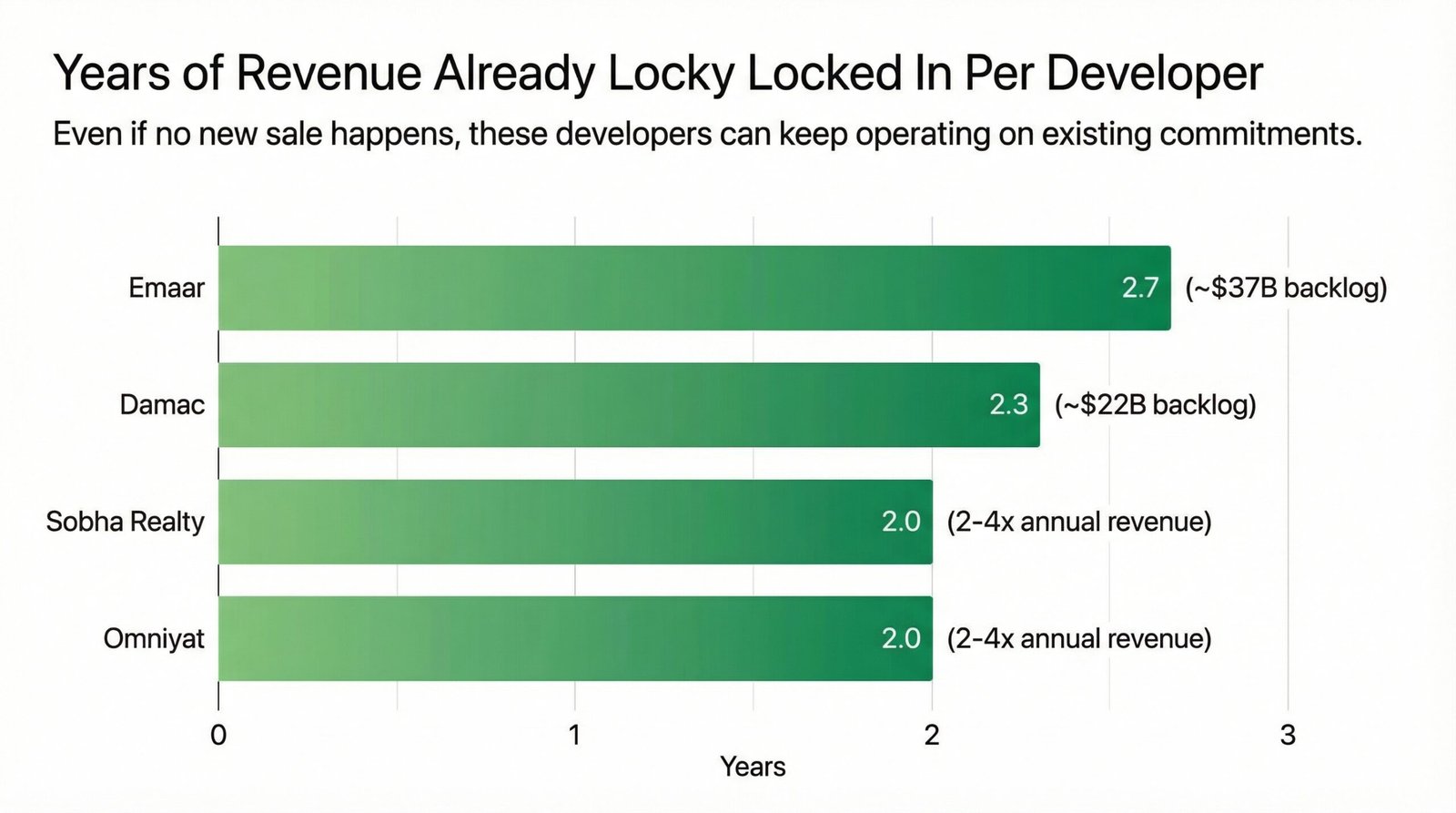
This is the single strongest argument against a market collapse. These backlogs mean construction continues, projects get delivered, and buyer commitments remain intact — regardless of what happens in the headlines.
How big is $10 billion, really?
Larger than Iceland’s GDP
Emaar’s $19.2B cash+escrow exceeds the entire economic output of Iceland.
Could build Burj Al Arab 15+ times
At $650M each, $10B in developer cash would fund an entire skyline.
33,000 average Dubai apartments
At AED 1.1M average price, their cash alone covers tens of thousands of units.
Central Bank backup on top
CBUAE has a 1 trillion AED resilience package ready to deploy.
2008 was a different animal
Every crisis in Dubai brings the same comparison: “Is this going to be like 2008?” S&P Global Ratings explicitly said no — and the data explains why:
| FACTOR | 2008 | 2026 |
| Root cause | Internal — credit bubble, speculation | External — geopolitical, not structural |
| Bank RE exposure | 30%+ of assets | 18.3% (capped at 30%) |
| Developer leverage | High — heavy debt loads | Low — strong cash positions |
| Revenue backlogs | Minimal presales buffer | 2–3 years locked in |
| Off-plan rules | Minimal — rampant flipping | 30–40% payment before resale |
| Buyer defaults | Developer takes total loss | Developer retains up to 40% |
| Price impact | ~50% collapse | Moderate decline expected |
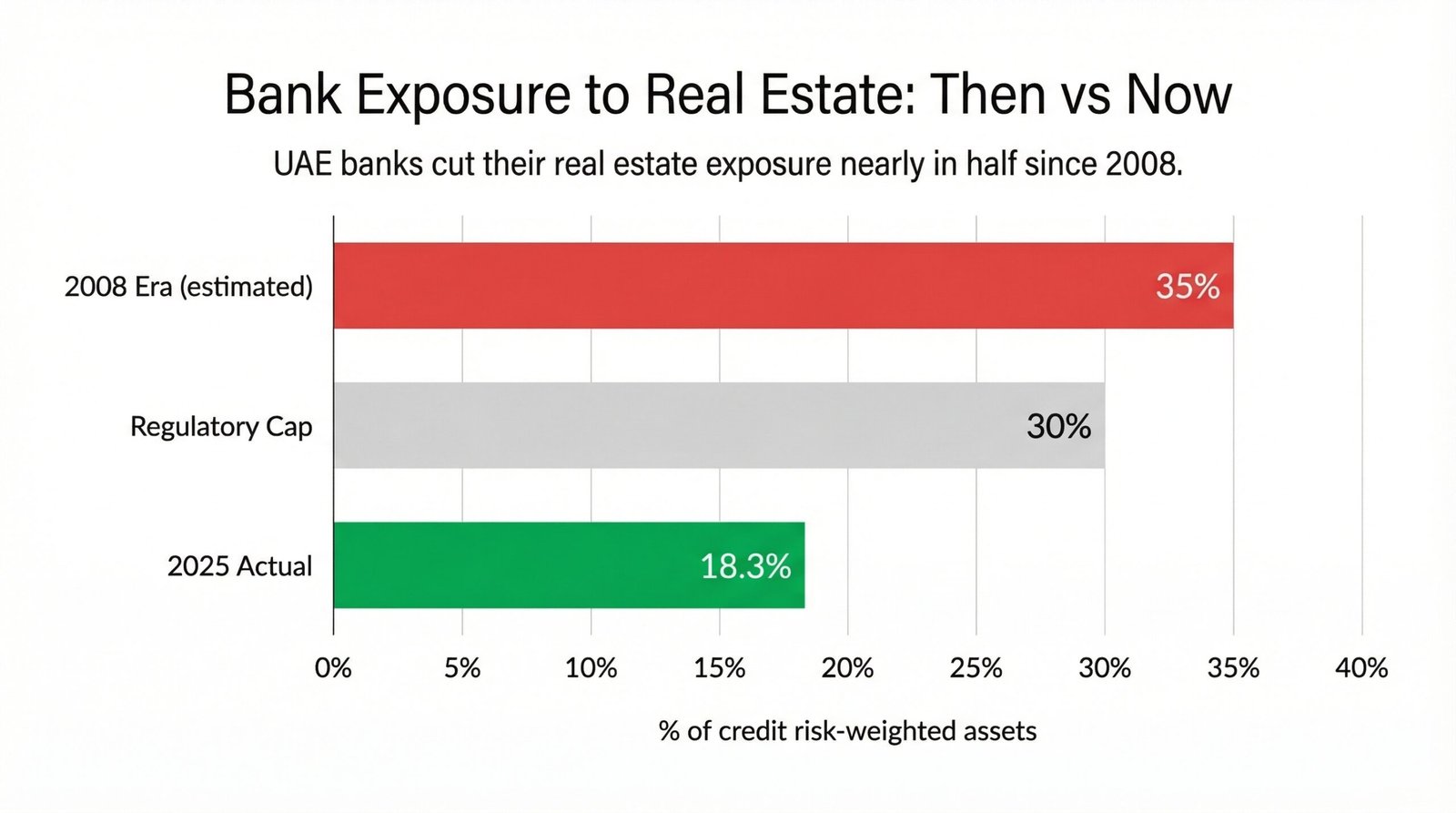
The difference is fundamental. In 2008, the crisis came from inside the market — overleveraged banks, speculative flipping, no regulatory guardrails. In 2026, the market’s internals are strong. The pressure is entirely external. Different disease, different prognosis.
Stock prices crashed. Property sales didn’t.
Perhaps the most revealing data point in this entire crisis is the divergence between what the stock market did and what actual property transactions did:
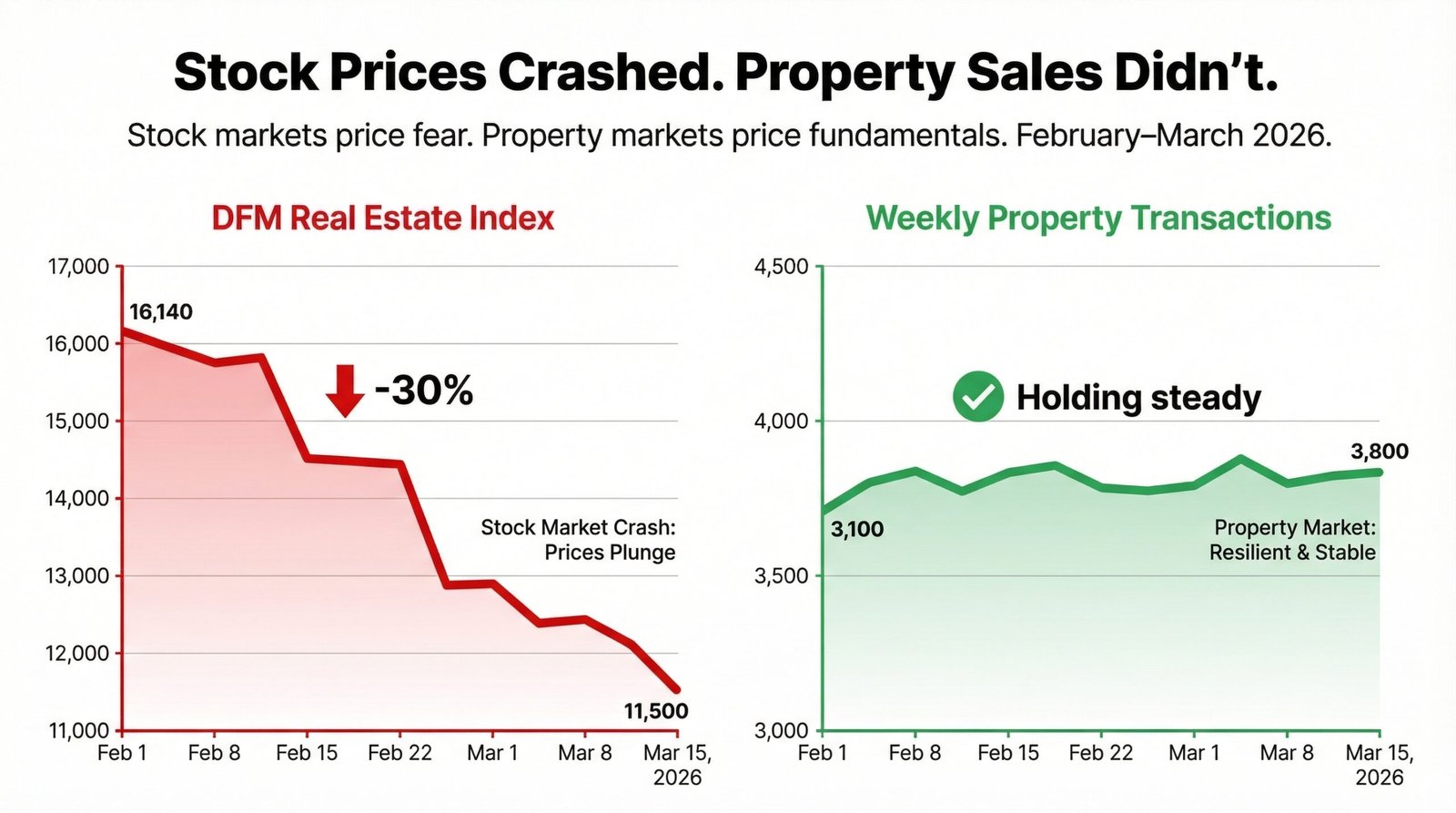
The DFM Real Estate Index dropped approximately 30% in under three weeks — its worst single-month decline since the index was created. Meanwhile, in the single week of March 2–9, Dubai recorded 3,570 property transactions worth AED 11.93 billion.
Stock markets are forward-looking machines that react instantly to sentiment, fear, and uncertainty. When missiles fly, institutional funds sell first and ask questions later. Property transactions move on fundamentals: location, value, long-term demand. Two different markets telling two very different stories.
If you own or are buying off-plan
Your project will get finished. Escrow balances mean construction money is already collected and ring-fenced. Emaar alone has $11.7 billion in escrow — that money exists solely to complete buildings under construction. Even if new sales stop entirely, projects continue because the funding is already there. Dubai demonstrated this exact resilience during COVID lockdowns: construction kept going.
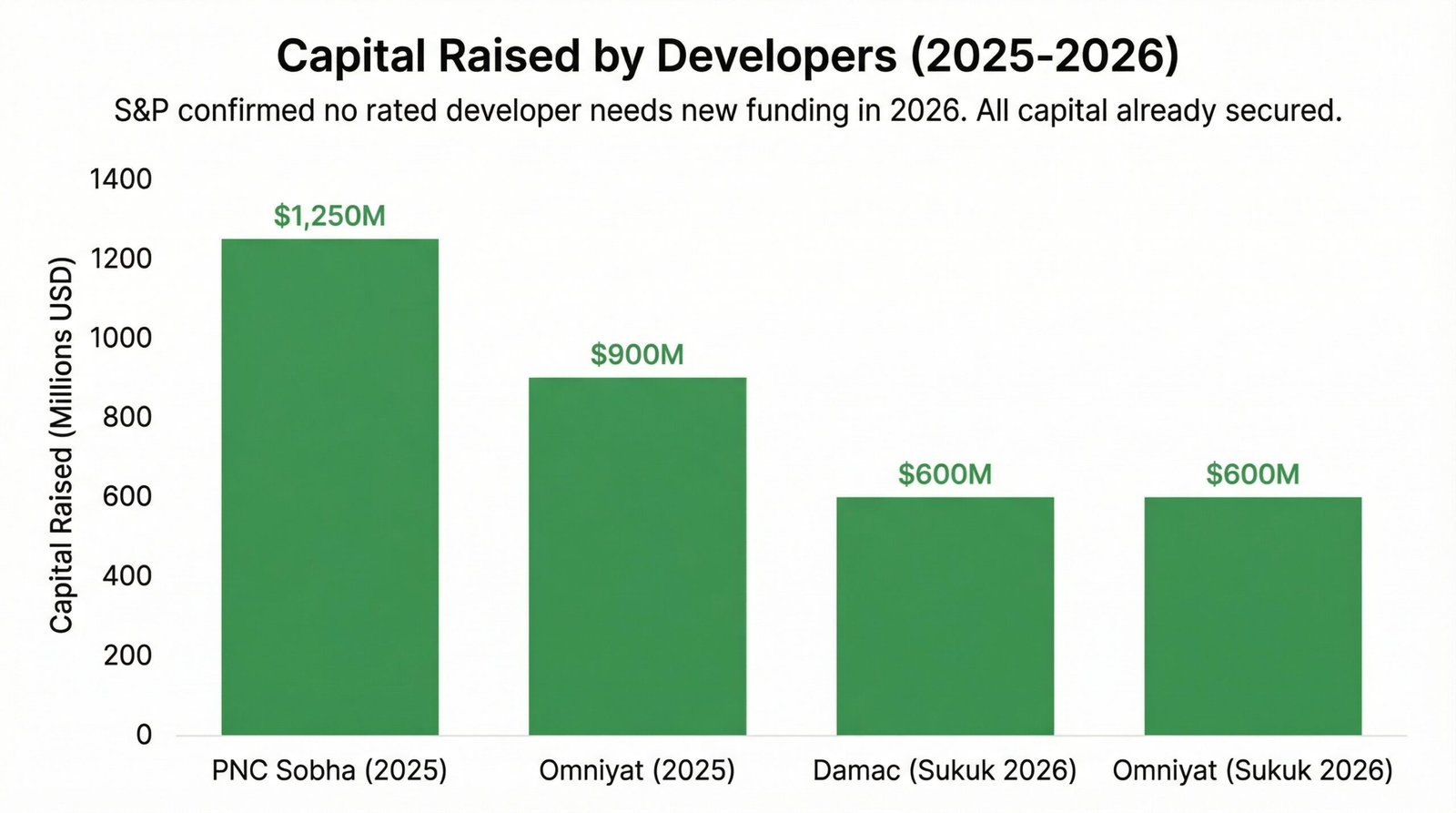
Developers have proactively raised capital. Damac and Omniyat each raised $600 million through sukuk issuances in early 2026. PNC secured $1.25 billion and Omniyat an additional $900 million in 2025. S&P confirmed no rated developer needs new funding in 2026.
Even Emaar’s massive $2.7–3 billion annual capex plan (Dubai Creek Tower, Dubai Creek Mall, Dubai Mall expansion) has built-in flexibility — S&P confirmed a significant portion can be delayed if conditions require it.
Crises test what was built in calm weather.
Dubai’s top developers spent the last 3 years building cash reserves, locking in revenue, and lowering debt. That preparation is the moat. Headlines come and go — balance sheets don’t lie.
FAQ
Will Dubai real estate crash in 2026?
According to S&P Global Ratings (March 2026), a crash similar to 2008 is unlikely. Dubai’s top 4 rated developers hold over $10 billion in cash reserves and 2–3 years of pre-sold revenue. Bank exposure to real estate has dropped from 35%+ in 2008 to just 18.3% today. S&P’s base case expects moderate price declines, not a structural collapse.
How much cash do Dubai developers have?
As of December 2025, Emaar holds $7.5 billion in cash plus $11.7 billion in escrow ($19.2B total). Damac holds $1.7 billion cash plus $6 billion escrow ($7.7B total). PNC Investments and Omniyat each hold approximately $600 million. Combined reserves exceed $28 billion.
Is it safe to buy off-plan property in Dubai during the crisis?
S&P confirmed that escrow-protected funds ensure construction continues even if new sales stop. Developers can retain up to 40% of property value if a buyer defaults, protecting project completion. No rated developer needs new funding in 2026. Construction has continued normally throughout the current crisis, as it did during COVID lockdowns.
What is the difference between Dubai 2008 crash and 2026?
In 2008, the crisis was structural: overleveraged banks, speculative flipping, minimal regulation. In 2026, the pressure is external (geopolitical) while market fundamentals are strong. Bank RE exposure is 18.3% vs 35%+, developers hold multi-year revenue backlogs, and off-plan buyers must pay 30–40% before reselling. S&P explicitly ruled out a 2008-style repeat.
All data from S&P Global Ratings — “Credit FAQ: How Long Can Dubai Residential Real Estate Withstand War-Related Strains?” (March 16, 2026)
Additional data: Moody’s Ratings, Dubai Land Department, CBUAE