For many UK investors exploring overseas property markets, the first—and often only—question is simple: “What’s the ROI?”
While rental yield is undeniably important, focusing on headline percentages alone can lead to fragile investment decisions—especially in a fast-moving market like Dubai.
When evaluating Dubai real estate investment communities, long-term performance is rarely driven by yield projections on a brochure. Instead, it depends on who actually lives in a community, how stable rental demand is, and how efficiently new supply is absorbed. In other words, people matter more than percentages.
This article explains why metrics such as resident density and absorption capacity offer a far more reliable framework for selecting the right Dubai community—particularly in the context of Dubai’s rapid population growth and evolving housing supply.
The Problem With ROI-First Thinking in Dubai Real Estate Investment Communities
Dubai is often marketed using eye-catching numbers: 8–10% rental yields, guaranteed returns, high-growth zones. While these figures attract attention, they rarely tell the full story.
ROI-focused decision-making overlooks several critical realities:
- Rental income is only realised if a unit is occupied
- Vacancy periods, rent discounts, and delayed handovers erode actual returns
- Speculation-driven demand often peaks early and fades quickly
A community can show strong yields on paper yet struggle with long-term occupancy. In contrast, some of the most resilient Dubai real estate investment communities consistently deliver moderate but stable returns—typically in the 6–8% range—because they attract real residents, not just investors.

What Actually Sustains Rental Income? People, Not Percentages
Sustainable rental income is driven by end-user demand, not investor hype. Communities that perform well over time share one defining characteristic: people choose to live there.
This is where resident density becomes a powerful lens.
Resident density is not simply the number of units in an area—it reflects how many of those homes are genuinely occupied, how integrated the community is, and whether residents see it as a long-term place to live.
High resident density typically signals:
- Strong infrastructure (schools, parks, retail, healthcare)
- Family-oriented layouts and amenities
- Social stability and lease renewals
- Organic demand through referrals and word-of-mouth
These dynamics are especially relevant for UK investors who value predictable income over speculative upside.
Understanding Resident Density in Dubai Real Estate Investment Communities
Resident density acts as a proxy for livability. Communities with high resident density tend to attract:
- Families relocating for work
- Long-term professionals
- Repeat tenants renewing leases
In Dubai, areas such as Dubai Hills Estate, Jumeirah Village Circle (JVC), and Mirdif demonstrate this clearly. These communities are not defined by luxury headlines but by everyday functionality.
When families move in, they rarely leave after one lease cycle. Schools, commute times, green space, and community services create friction against churn—protecting landlords from vacancy risk.
Absorption Capacity: The Metric Most Investors Ignore
Absorption capacity refers to how efficiently a market or community can absorb new housing supply without destabilising rents or occupancy levels.
This metric becomes crucial when supply volumes increase.
In 2025, Dubai added over 200,000 new residents, while approximately 42,000 residential units were handed over. Around 45,000 additional units are expected in 2026. While this supply is substantial, it is not evenly distributed—and not all communities can absorb it equally.
Strong Dubai real estate investment communities share three traits:
- Consistent population inflow
- Balanced supply pipelines
- Proven rental demand from end users
Where absorption capacity is weak, new handovers can quickly lead to:
- Increased vacancy
- Rent competition between landlords
- Short-term incentives that erode net yield

Case Studies: Why Some Dubai Communities Keep Performing
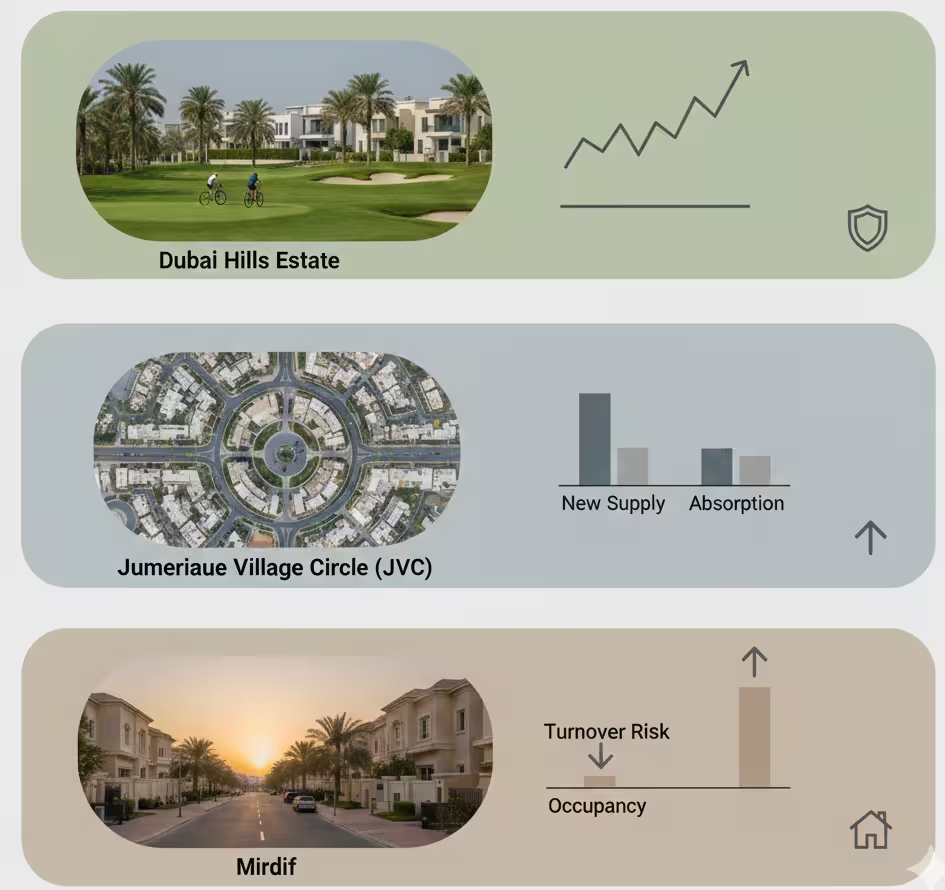
Dubai Hills Estate
Dubai Hills benefits from master-planned infrastructure, proximity to business hubs, and strong appeal to families. Resident density remains high because tenants renew leases, reducing turnover risk. Yields typically sit between 6–7%, but income stability is the real advantage.
Jumeirah Village Circle (JVC)
Often misunderstood as “overbuilt,” JVC continues to perform due to its affordability, accessibility, and growing amenities. Its absorption capacity has historically outpaced new supply, particularly for mid-market rental units. This makes it one of the more resilient Dubai real estate investment communities.
Mirdif
Mirdif rarely appears in investor brochures, yet it consistently attracts long-term residents. Low turnover, stable rents, and limited speculative development help maintain occupancy—even during market slowdowns.
The Risk of Speculation-Heavy Projects
Speculation-driven developments often share similar patterns:
- Heavy off-plan investor demand
- Limited appeal to end users
- Rapid price appreciation followed by rental softness
These projects can show impressive short-term ROI figures, but when large volumes of units are handed over simultaneously, absorption slows. Vacancy rises, and landlords compete on price.
For UK investors accustomed to regulated, tenant-driven markets, this volatility introduces unnecessary risk—especially when more stable alternatives exist.
Data Snapshot: Comparing Dubai Real Estate Investment Communities
| Community | Resident Density | Absorption Speed | Typical Yield Range | Vacancy Risk |
| Dubai Hills Estate | High | Strong | 6–7% | Low |
| JVC | Medium–High | Strong | 6–8% | Low–Medium |
| Mirdif | High | Moderate | 6–7% | Low |
| Speculative Off-Plan Zones | Low–Medium | Weak post-handover | 8–10% (projected) | High |
This comparison highlights a key insight: yield alone does not define performance. Stability is shaped by resident behaviour and absorption dynamics.
The Smarter Questions UK Investors Should Ask
Instead of asking only “What’s the ROI?”, experienced investors should ask:
- Who is actually moving into this community?
- Is demand driven by end users or investors?
- How reliable is the developer’s delivery history?
- Can the community absorb future supply without pressure on rents?
These questions sit at the heart of successful decision-making in Dubai real estate investment communities.
Conclusion: Beyond ROI, Toward Sustainable Performance
ROI is an outcome—not a strategy.
In Dubai’s evolving property market, long-term success depends on understanding human behavior, not just financial projections. Communities with strong resident density and proven absorption capacity consistently outperform speculative alternatives, even if their headline yields appear lower.
For UK investors seeking sustainable income, capital preservation, and reduced volatility, the smartest investments are often found where people choose to stay—not where numbers look the most impressive.
Call to Action
For UK investors seeking sustainable income, capital preservation, and reduced volatility, professional guidance makes all the difference. Book a private consultation to assess community fundamentals, absorption dynamics, and developer reliability before making your next investment decision.