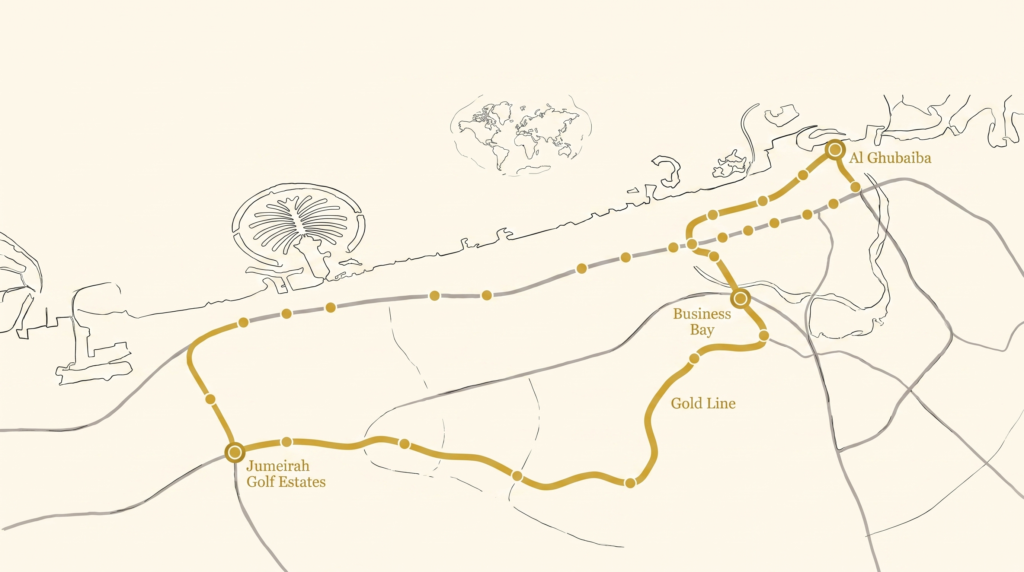
If you are a UK investor looking at Dubai from a London, Manchester or Edinburgh postcode, the announcement of the Dubai Metro Gold Line is one of the more consequential property signals you will see this decade. AED 34 billion, 18 stations, 42 kilometres, opening in September 2032 — all running through a corridor that contains many of the neighbourhoods British buyers are already allocating into.
The more useful question is not whether this is big news (it is), but whether it is actionable news for you. The honest answer depends on two things: what Dubai’s previous metro expansions actually did to property prices, and which Gold Line districts fit your particular risk, yield and time-horizon profile.
This guide walks through both — the historical data and the area-level detail — specifically for UK-based investors. Price ranges are quoted in both sterling and dirham throughout, converted at roughly £1 = AED 4.7.
Why UK investors keep allocating to Dubai
Before we get to the Gold Line, the backdrop. British nationals remain one of the largest foreign-buyer cohorts in Dubai property, and the structural reasons behind that have not changed:
- Tax efficiency on the Dubai side. No annual property tax, no capital gains tax, no inheritance tax on Dubai real estate. A one-off 4% Dubai Land Department fee at purchase is the main transactional cost.
- Higher gross yields than prime UK. Apartments along the Gold Line corridor typically gross 6–9% depending on area and unit type, versus roughly 4–5% gross for comparable London stock.
- Freehold ownership. The entire Gold Line corridor is inside designated freehold zones. UK nationals can own 100% of the title with no local sponsor.
- The Golden Visa. A property investment of AED 2 million (roughly £425,000) qualifies the buyer and family for a 10-year renewable UAE residency visa.
- English-language legal plumbing. The DIFC Courts operate under English common law, familiar to UK investors and their advisers.
- Logistics. Seven-hour direct flight from London, same time zone as a late UK workday, no visa required for short visits.
UK residents should remember that Dubai’s tax treatment does not remove their UK tax exposure — rental income and capital gains on Dubai property remain taxable in the UK for UK residents. A competent UK tax adviser should be part of any serious Dubai allocation.

The metro premium: what Dubai’s last two expansions actually did to prices
The Gold Line is not Dubai’s first metro project. It is the third major line. That is good news for anyone trying to assess likely impact, because we have two prior natural experiments to look at: the original Red Line (opened 2009–2010) and the Route 2020 extension (opened January 2021).
Broadly speaking, three findings show up consistently in broker reports, Dubai Land Department transaction data and research from firms including Knight Frank, Cavendish Maxwell, Core, Property Finder and Bayut:
- A persistent metro-proximity premium. Properties within roughly 500–800 metres of a metro station typically command a 10–20% premium over otherwise similar stock further away.
- A front-loaded price reaction. A meaningful portion of the total uplift happens between announcement and opening, not after opening. By the time the line is running, the premium is largely priced in.
- The largest proportional gains happen in previously under-served areas. A new metro station moves the needle far more in a district that had no rail access than in one that was already well-served.
The Red Line (2009): the original benchmark
The Red Line opened in stages between 2009 and 2011, with headline stations at Dubai Marina, JLT, Business Bay and along Sheikh Zayed Road. The timing was difficult — the 2008 global financial crisis hit Dubai property hard in 2009 and 2010 — which makes isolating the metro effect from the market cycle genuinely tricky.
What is clearer is the long-run outcome. Dubai Marina and JLT, both of which sat on the Red Line from day one, became two of the most liquid rental and resale markets in the city. A buyer who acquired in 2010–2012 at post-crash prices and held through to 2024 saw very strong total returns, driven by a mix of market recovery, metro access and the maturation of those districts into full live-work neighbourhoods.
Business Bay, which gained its Red Line station in 2010, is another useful reference point. Between 2020 and 2024, apartment prices in Business Bay appreciated by an estimated 60–80%, meaningfully ahead of the Dubai-wide average. Some of that is the broader 2021–2024 Dubai cycle; some of it is the station.
Route 2020 (January 2021): the cleaner natural experiment
The Route 2020 extension is a better experiment for our purposes — it opened as Dubai’s market was recovering, not collapsing. Seven new stations running from Nakheel Harbour to the Expo 2020 site, passing through Al Furjan, Discovery Gardens, Dubai Investment Park and ending near Expo City and Dubai South.
Post-opening performance across the Route 2020 corridor is where the metro-premium story becomes most visible in the data:
- Al Furjan apartment prices rose by roughly 40–60% between 2020 and 2024, outperforming the Dubai city-wide apartment index over the same period.
- Discovery Gardens saw similar appreciation of roughly 40–55%, one of the strongest runs in Dubai’s affordable apartment segment.
- Dubai Investment Park — previously a semi-industrial, low-liquidity area — gained meaningful investor and end-user demand post-metro, with both apartment and villa pricing stepping up materially.
- Jumeirah Golf Estates villa transactions accelerated as the Expo / Route 2020 infrastructure pushed perceived accessibility of Dubai’s western edge.
It is worth noting the obvious caveat: Route 2020 opened into one of the strongest Dubai property cycles on record. Not all of the appreciation above is metro-driven. A reasonable rule of thumb from broker analysis is that roughly 10–20 percentage points of the total appreciation in these areas can be attributed specifically to metro access, with the remainder reflecting the wider market cycle.
Historical metro-era performance at a glance
| Area | Metro event | Approx. price movement (apartments) | Approx. price movement (villas / townhouses) |
|---|---|---|---|
| Dubai Marina | Red Line, 2009 | Recovered to peak values within ~5 years; ~10–15% metro-proximity premium persists vs non-metro stock nearby. | n/a (apartment-dominated) |
| JLT | Red Line, 2009 | Emerged as a full commercial/residential hub; long-run appreciation broadly in line with Marina. | n/a |
| Business Bay | Red Line, 2010 | ~60–80% price appreciation between 2020 and 2024, ahead of the city-wide average. | n/a |
| Al Furjan | Route 2020, Jan 2021 | ~40–60% price growth between 2020 and 2024 (various broker reports). | Townhouses up in a similar range; strong end-user demand post-metro. |
| Discovery Gardens | Route 2020, Jan 2021 | ~40–55% price growth, one of the strongest affordable-segment runs in Dubai. | n/a |
| Dubai Investment Park | Route 2020, Jan 2021 | Substantial appreciation from a low base; liquidity and rental demand both improved sharply. | Villa/townhouse price uplift visible in transaction data. |
| Expo City / DSO corridor | Route 2020 + Expo 2020 | Mixed — new supply dilutes some uplift, but infrastructure-adjacent stock outperforms. | Villa growth strong in Tilal Al Ghaf, Dubai South villa clusters. |
Figures above are approximate mid-range estimates drawn from public broker reports and Dubai Land Department transaction trends. Individual unit performance varies significantly by tower, floor, view, and handover date.
Will the Gold Line repeat the pattern?
Nothing in property is guaranteed, and anyone who tells you otherwise is selling something. But the structural setup for the Gold Line is, if anything, stronger than the Route 2020 setup was at the equivalent point in its own cycle. Here is the honest bull / bear read.
The bull case
- The corridor is underserved today. Unlike the Red Line, which largely reinforced already-developed Sheikh Zayed Road, the Gold Line cuts through several districts — Al Barsha South, JVC, Dubai Sports City, Dubai Studio City — that currently have no rail access. Proportional uplift in these zones should be large.
- 2040 demand is already in the plan. Dubai’s 2040 Urban Master Plan targets a population of roughly 5.8 million, up from around 3.8 million today. The Gold Line is sized for that 5.8 million city, not today’s 3.8 million.
- Etihad Rail integration widens the demand pool. Meydan and Jumeirah Golf Estates will have both Gold Line and Etihad Rail access, putting them on a one-hour rail spine to central Abu Dhabi. That widens addressable demand from Dubai buyers to the entire UAE (and potentially GCC) buyer pool.
- The D33 agenda and visa liberalisation support demand. Dubai’s D33 economic programme targets doubling GDP by 2033, and Golden Visa reform has already extended long-term residency to investors, retirees and skilled professionals. Both support the rental demand side of the equation.
- The 2026–2032 announcement window works in buyers’ favour. Historic pattern: a meaningful portion of metro-driven appreciation happens between announcement and opening. Buyers entering in 2026–2028, before construction is fully visible, have historically captured more of that than buyers entering in the 12 months before opening.
The bear case
- Supply. Dubai is mid-cycle for off-plan launches. Between now and 2032, a very large volume of new apartments will be handed over across the Gold Line corridor — particularly in JVC, Business Bay and MBR City. Heavy supply can dampen near-term capital appreciation even when demand is strong.
- Construction risk. 2032 is seven years away. Delays to either the metro line itself or key corridor developments can push out the catalyst.
- Macroeconomic cycle. Global interest rates, oil prices, and GCC regional dynamics all affect Dubai pricing. The underlying metro thesis does not insulate a buyer from a broader correction.
- Currency. The dirham is pegged to the US dollar. For UK buyers, a strong GBP/USD cycle is helpful at entry but a weak GBP/USD cycle at exit can erode sterling returns even when the AED price has risen.
Service charges and holding costs. These are often under-modelled by first-time Dubai investors. Premium communities can carry service charges of AED 15–25 per sq ft per year, which directly affect net yield.
The Gold Line is not a free lunch. It is a large, high-probability tailwind — strongest for buyers who pick the right micro-location, hold through 2032, and underwrite honestly for supply and service charges.
The five Gold Line areas UK investors should be looking at now
Not every Gold Line station is equally interesting for a UK investor. Below are the five areas that, in our view, offer the best risk-adjusted exposure depending on your goals. Price ranges reflect mid-2026 broker asking levels and should be treated as indicative, not exact.
| Area | UK investor profile | Today’s typical entry (apartments) | Gross yield / thesis |
|---|---|---|---|
| Business Bay | Core + liquid. Safe first allocation. | 1-bed: £240k–£360k (AED 1.1M–1.7M) | 6–7% gross. Super-hub uplift + mature resale market. |
| JVC | Yield-first. Mid-market, high liquidity. | 1-bed: £130k–£200k (AED 600k–950k) | 7–9% gross. Highest proportional uplift from metro arrival. |
| Al Barsha South | Value play. Currently under-priced vs neighbours. | 1-bed: £150k–£230k (AED 700k–1.1M) | 7–8% gross. Cat-changing access upgrade in 2032. |
| Meydan / MBR City | HNW residential + Etihad Rail catalyst. | 1-bed: £320k–£550k (AED 1.5M–2.6M) | 5–6% gross. Capital-growth led, GCC-commuter thesis. |
| Jumeirah Golf Estates | Villa buyers, Golden Visa seekers. | Villa: £850k–£3M+ (AED 4M–14M+) | 4–5% gross. Western anchor + Etihad Rail terminus. |
1. Business Bay — the safe core allocation
Business Bay is the one address on the Gold Line that a conservative UK investor can defend on its existing merits alone, even before the Gold Line is factored in. It is already one of the most liquid apartment markets in Dubai, sits on the Red Line today, and backs directly onto Downtown and the Burj Khalifa.
On opening day in 2032, it becomes Dubai’s first triple-mode super-hub: Red Line, Gold Line, and the Dubai Canal marine network all meeting at a single point with walking access to Downtown and Dubai Mall. That is the kind of interchange density that, historically, reshapes surrounding real estate values for a generation — compare King’s Cross in London after the Eurostar terminal move.
What a UK investor gets here: a mature resale market, English-speaking letting agents on every corner, and a defensible rental story to both the corporate and short-let markets. Entry for a 1-bed is typically £240,000–£360,000 (AED 1.1M–1.7M) for ready stock, with off-plan available below the lower end of that range. Gross yields of 6–7% are realistic.
Best for: first-time UK buyers in Dubai, yield + modest-growth investors, buyers who want the most liquid resale market on the corridor.
2. Jumeirah Village Circle (JVC) — the yield and volume play
JVC is the single area where the proportional uplift from the Gold Line is likely to be largest. It is already one of Dubai’s fastest-growing mid-market residential zones, with dense population, young demographics, strong rental demand — and no existing metro access. Commutes into Sheikh Zayed Road at peak are the primary drag on the area today.
In 2032 that drag is removed. If the Route 2020 precedent — Al Furjan and Discovery Gardens at 40–60% appreciation post-metro — holds, JVC is the most direct analogue on the Gold Line corridor. It shares the profile: mid-market, high liquidity, chronic traffic, immediately upstream of the new station.
Entry for a 1-bed typically sits in the £130,000–£200,000 band (AED 600k–950k). Gross yields of 7–9% are common. This is where UK investors looking to build a mini-portfolio of 2–3 units often concentrate.
Best for: yield-first investors, buyers building a multi-unit position, sub-£200k entry points.
3. Al Barsha South — the value play
Al Barsha South is the most under-priced area on the Gold Line relative to its post-2032 connectivity profile. It is one of the largest residential zones in Dubai that currently sits without direct metro access, and its 2032 station is pencilled in between Al Quoz and Dubai Hills — two areas that already trade at higher premium per square foot.
A UK investor looking for the classic under-priced infrastructure play — buy next to a catalyst before the market fully reprices it — has a decent argument here. 1-bed apartments typically trade in the £150,000–£230,000 range (AED 700k–1.1M) with gross yields in the 7–8% band.
Best for: value-led investors, medium horizon (5–8 years), buyers comfortable with holding through the construction phase for 2032 upside.
4. Meydan / MBR City — the HNW + Etihad Rail thesis
Meydan sits at the single most transformative point on the Gold Line. It becomes an interchange between the Gold Line and Etihad Rail, which means a Meydan resident in 2032 can board a metro, transfer to Etihad Rail at the same station without surfacing, and be in central Abu Dhabi in approximately 60 minutes. For context, that trip today at peak hours is 2–2.5 hours by road.
This is not a yield play. It is a capital-growth thesis with a very specific catalyst: the repricing of Meydan from “premium Dubai residential district” to “UAE-integrated, GCC-commutable HNW address.” The addressable buyer pool for Meydan effectively widens from the Dubai workforce to the entire UAE workforce, plus international HNW buyers who value the golf-community and horse-racing brand.
Entry is higher. 1-bed apartments typically run £320,000–£550,000 (AED 1.5M–2.6M). Villas in MBR City sub-districts run from around £1 million (AED 4.7M) upward, with plenty of stock above £2 million. Gross yields are more modest, 5–6%, but the growth profile is the most interesting on the line.
Best for: UK HNW buyers, Golden Visa seekers at the AED 2M threshold, growth-led investors comfortable with lower yield.
5. Jumeirah Golf Estates — the villa anchor
Jumeirah Golf Estates (JGE) is the Gold Line’s western terminus and the second Etihad Rail interchange on the corridor. For UK villa buyers, this is the single most strategically positioned luxury community in the 2032 Dubai plan: a mature freehold golf community with direct metro access to Business Bay in roughly 35 minutes and to central Abu Dhabi in roughly 90 minutes via one underground transfer.
Villa pricing ranges widely — from around £850,000 (AED 4M) for a smaller townhouse to £3 million+ (AED 14M+) for prime detached villas fronting the Fire or Earth courses. Gross yields on villas sit lower, typically 4–5%, but the product is defensive, end-user driven, and clearly above the Golden Visa threshold for UK buyers allocating for residency.
Best for: UK family buyers relocating to Dubai, Golden Visa-led allocations, trophy-villa buyers looking for capital preservation + connectivity.
Practical considerations for UK buyers
The metro thesis is only half the decision. The other half is the mechanical side: how the transaction works, how tax lands, how financing is arranged, and what currency exposure you are really taking.
| Consideration | Detail for UK-based buyers |
|---|---|
| Ownership | Gold Line corridor sits entirely inside designated freehold zones. UK nationals can own 100% of the title with no local partner. |
| Taxes in Dubai | No annual property tax, no capital gains tax, no inheritance tax on Dubai property. A one-off 4% Dubai Land Department transfer fee applies at purchase. |
| UK tax treatment | UK residents remain taxable in the UK on worldwide income and gains. Rental income is UK-taxable; capital gains on sale are UK-taxable. Consult a UK tax adviser before exchanging. |
| Mortgage access | Non-resident mortgages available from UAE banks, typically up to 50–60% LTV for off-plan and 60–75% for ready. Rates vary; UK-based specialist brokers can arrange. |
| Currency | AED is pegged to USD at ~3.67. GBP/AED therefore mirrors GBP/USD. A weaker dollar cycle improves UK buyer entry; a stronger dollar cycle reduces it. |
| Golden Visa | Property investment of AED 2M (~£425k) or more qualifies for the UAE 10-year Golden Visa, renewable. Covers spouse and children. |
| Legal framework | DIFC Courts operate under English common law and English language — familiar for UK investors and commercial parties. |
| Rental management | Full letting/management services typically 5–8% of gross rent. Airbnb/short-let permits available in most Gold Line areas, subject to DTCM rules. |
A few additional points worth underlining specifically for UK residents:
- UK tax applies on worldwide income and gains. The absence of Dubai-side tax is useful, but it does not replace UK tax. Structure planning (ownership vehicle, spouse ownership split, use of available UK reliefs) should happen before exchange, not after.
- Off-plan payment plans are cash-flow friendly. Many Gold Line corridor developers offer 50/50 or 60/40 schemes with 1–3% monthly milestones — which for a sterling buyer effectively dollar-cost averages the currency exposure over 2–4 years.
- Letting management is straightforward. Professional management is standard in Dubai, typically 5–8% of gross rent for long-let and 15–20% for short-let. That lets UK-based landlords run a fully-managed position from London with minimal friction.
Inheritance planning. Dubai does not impose inheritance tax on property. UK inheritance tax, however, still applies on a UK-domiciled person’s worldwide estate. A Dubai-registered will through DIFC Wills alongside your UK will is the normal setup.
Risks, caveats and what would make us wrong
A fair investment case includes what would make us wrong. For the Gold Line thesis, the three biggest risk vectors are:
- Heavy new supply between now and 2032. Dubai is mid-cycle on off-plan launches. If completion volumes in JVC, Business Bay or MBR City run well above demand growth through 2028–2030, near-term capital appreciation could underperform even while the long-term metro thesis holds.
- Construction or timeline slippage. Announced opening is 09 September 2032. A one- to two-year delay is well within the normal range for metro projects of this scale globally. This compresses IRR for any buyer underwriting a hold-to-opening exit.
- Currency. A sustained strong-dollar cycle can reduce sterling-returns even when dirham prices are rising. UK buyers should not model returns purely in AED.
None of these are reasons to sit out the corridor. They are reasons to underwrite conservatively: assume heavier supply than the brochure suggests, allow a 12–18 month cushion on opening, and stress-test returns against a 10% GBP/USD move in either direction.
Bottom line
Dubai’s last two metro expansions both generated persistent, measurable premiums for well-located stock inside their corridors — somewhere in the order of 10–20 percentage points of appreciation attributable specifically to metro access, on top of whatever the wider market did. The Gold Line’s setup is, if anything, more favourable: larger investment, more underserved districts, Etihad Rail integration, and a 2040 population target that requires the corridor to actually get used.
For UK investors, the corridor splits cleanly into three plays:
- Yield and volume: JVC, Al Barsha South.
- Core and liquidity: Business Bay.
- Capital growth and GCC connectivity: Meydan / MBR City, Jumeirah Golf Estates.
The question is not whether to pay attention to the Gold Line. It is which of those three plays fits your horizon, your ticket size, and your sterling-based return requirements.
Next steps
Browse UK-investor-ready properties along the Gold Line corridor, or book a consultation to build your 2032 allocation strategy.