
Two UAE announcements landed within a week of each other last month. Most of the British investors I speak with have only registered one of them. Together, they tell a story I think the UK property world will look back on as a turning point — and the kind of moment people quietly position around before everyone else catches on.
A confidence move, not a crisis one
On 28 April, the UAE confirmed it was leaving OPEC and OPEC+ after almost sixty years of membership. The exit took effect on 1 May. The headline has been read in some quarters as instability — a Gulf state walking out during an active regional crisis, with Iran tensions still live and the Strait of Hormuz being talked about on every business desk in London.
That reading is the wrong one.
The UAE has been capped at roughly 3.2 million barrels a day under OPEC quotas. Its own ambition is 5 million by 2027. You don’t quit a cartel because you’re scared; you quit because the cartel is costing you money. This is a country saying, in writing, that it intends to produce and sell more of its own oil on its own terms — and it’s doing it from a position of confidence, not weakness.
For investors, the more interesting question is what happens to the money.
What history tells UK investors about moments like this
Every previous regional flare-up has done the same thing to Dubai property: it’s pulled capital in, not pushed it out. Look at 2003, 2006, 2011, the 2019–20 Yemen escalation. In each case, regional wealth — and a fair chunk of European and South Asian wealth — went looking for somewhere safe, liquid, and professionally managed. Dubai has been the destination of choice for that money for over twenty years.
The current cycle is doing the same thing on the official numbers. Q1 2026 in Dubai: AED 138.7 billion in property sales, 44,150 transactions, transaction value up 21.2% year on year. That isn’t a market trying to find its feet. It’s a market with serious depth.
The honest caveat — and the reason I’m not telling clients to throw caution out the window — is that the Hormuz situation does create short-term volatility. Some buyers, particularly cautious ones in the UK, are pausing to wait for clarity on the peace talks (mediators in Pakistan are expecting a revised Iranian proposal within days). That hesitation is precisely where opportunity tends to sit, but only for buyers willing to take a measured view.
The quieter news most UK buyers are sleeping on
The second story is less dramatic, but for British buyers it might be the more useful of the two.
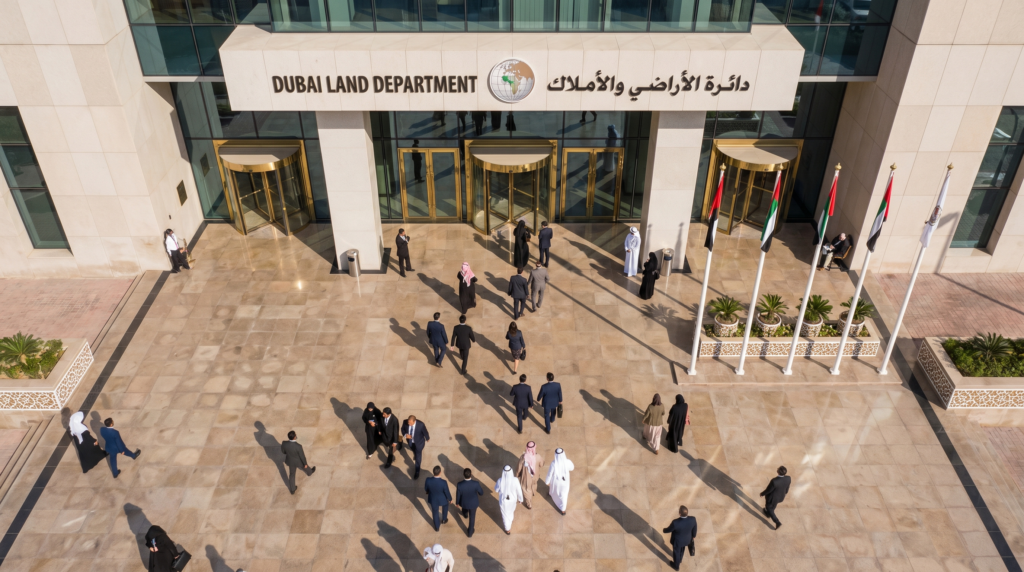
On 29 April, the rules around Dubai’s 2-Year Property Owner Residence Visa changed. Two big shifts:
- Sole owners. If you’re the sole owner of a Dubai property, the previous AED 750,000 minimum value has been removed. There’s no longer a property value floor to qualify.
- Joint owners. If you’re buying with someone else — a spouse, a sibling, a business partner — each individual share simply needs to be AED 400,000 or more. Each of you qualifies independently, even where ownership is split equally.
In practical terms: a couple buying together at AED 800,000 (somewhere in the region of £170,000–£175,000 at current rates) now both qualify for UAE residency in their own right. That is a step-change in accessibility. The visa was previously framed as a high-net-worth perk; under the new rules it functions much more like a residency pathway tied to ordinary property ownership.
The visa itself is renewable, lets you sponsor your spouse and children, and unlocks an Emirates ID — which in turn opens up local banking, healthcare, and the practical things that make Dubai actually liveable rather than just visitable.

Why this combination is what investors wait years for
Take the two stories together and you get a picture I think UK investors should be paying close attention to.
On one side, you have a country making an explicit, public commitment to expand its economy outside cartel quotas — meaning more oil revenue, continued infrastructure investment, and a government balance sheet getting stronger over the medium term. On the other, you have a residency pathway that’s now within practical reach for the kind of UK buyer who would previously have been priced out of it.
The pattern, at the level of capital flows, is the one I keep coming back to: regional uncertainty plus UAE strategic confidence has historically pulled investors toward Dubai, not away from it. The new visa rules then give those investors something to do — a tangible foothold, with residency attached, at a price point that opens the door to a far wider segment of the British market.
| CURRENT OPPORTUNITIES See the projects I’m shortlisting for UK investors this quarter. A handpicked mix of off-plan and ready-to-move properties priced from around AED 800,000, selected with the new visa rules and resale dynamics in mind. Browse current opportunities → |
A word on the numbers, from a UK perspective
I won’t pretend Dubai is for everyone. But it’s worth holding what’s on the table here next to a typical UK buy-to-let.
Gross yields in well-chosen Dubai areas are still running at 6–8% — substantially above what a London or Home Counties BTL produces once stamp duty, mortgage costs, and tax sit on top of it. The dirham is pegged to the US dollar, which gives UK investors a far cleaner view on currency than markets where the local unit floats freely. There’s no annual property tax in Dubai, no personal capital gains tax on property, and the transaction structure is fundamentally simpler than what most British buyers are used to back home.
None of that makes Dubai a magic bullet. It does mean the maths is genuinely different from a UK BTL, and worth running properly rather than dismissing on instinct.
How I’d approach this if I were sitting in London right now
If I were a UK investor reading this and trying to work out what to do, my honest answer would be: don’t try to call the Hormuz situation, but do start the work.
That means deciding what kind of property fits your goals (income, growth, or residency-driven), getting your name on the right shortlists for projects coming to market this quarter, and understanding the visa pathway before you buy rather than after. Most of the people I see making well-timed moves are the ones who did the prep work in the quiet months and were ready when the wider market caught up.
Markets reward the people who do the homework before the headlines, not after. If Dubai is on your radar — even as a maybe — this is the year to do that homework properly.
TWO WAYS TO TAKE THIS FURTHER
| PERSONAL CONSULTATION Book a free 30-minute consultation. We’ll go through your goals, your budget, and whether the residency pathway makes sense for you — with no obligation to buy and no hard sell. UK time slots available. Schedule a call → |
| STAY ONE STEP AHEAD Get the monthly UK Investor Briefing. A short, no-fluff email every month — Dubai market data, regulatory changes, and the projects I’m watching. Written specifically for British buyers. Get on the list → |