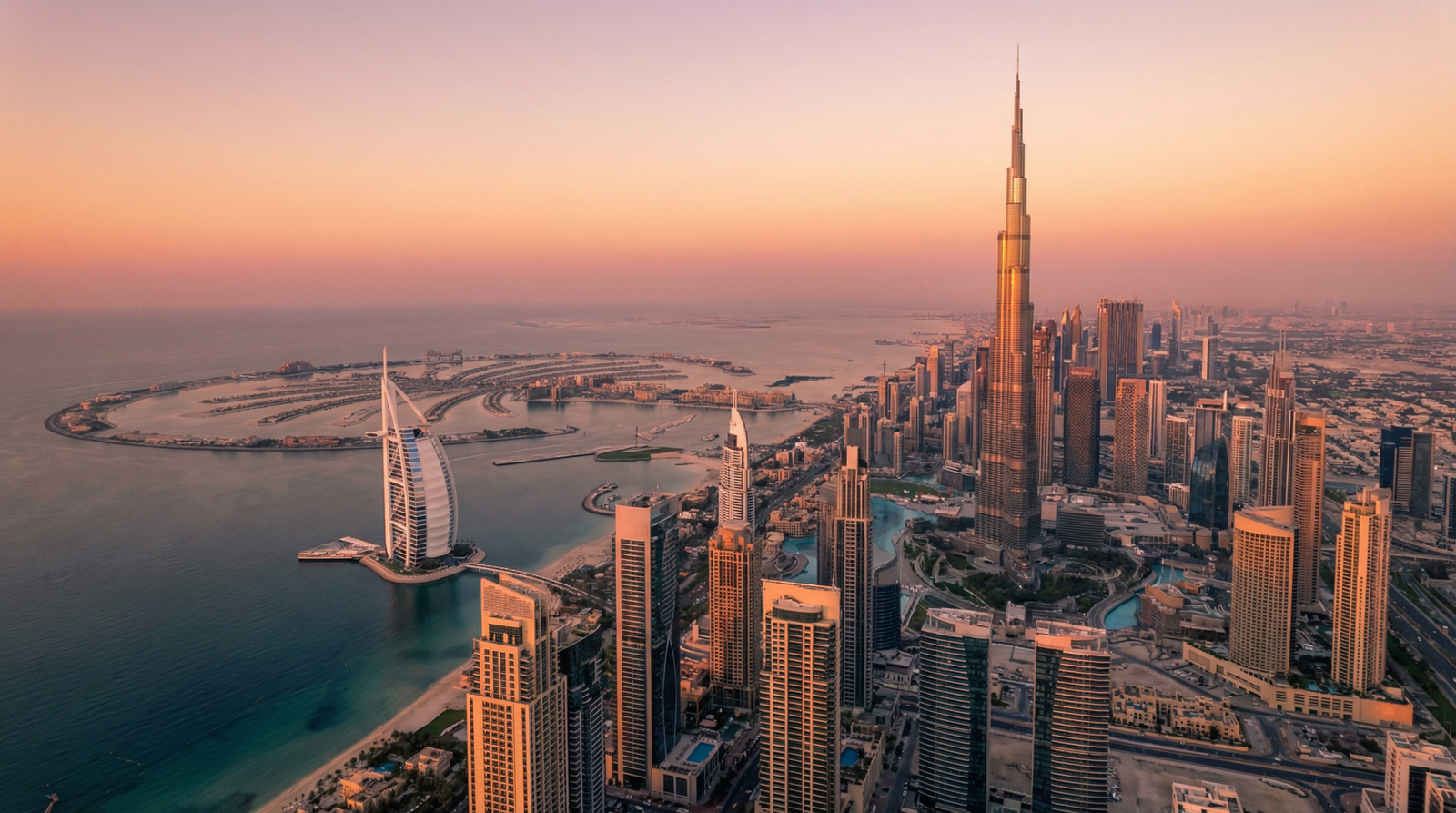
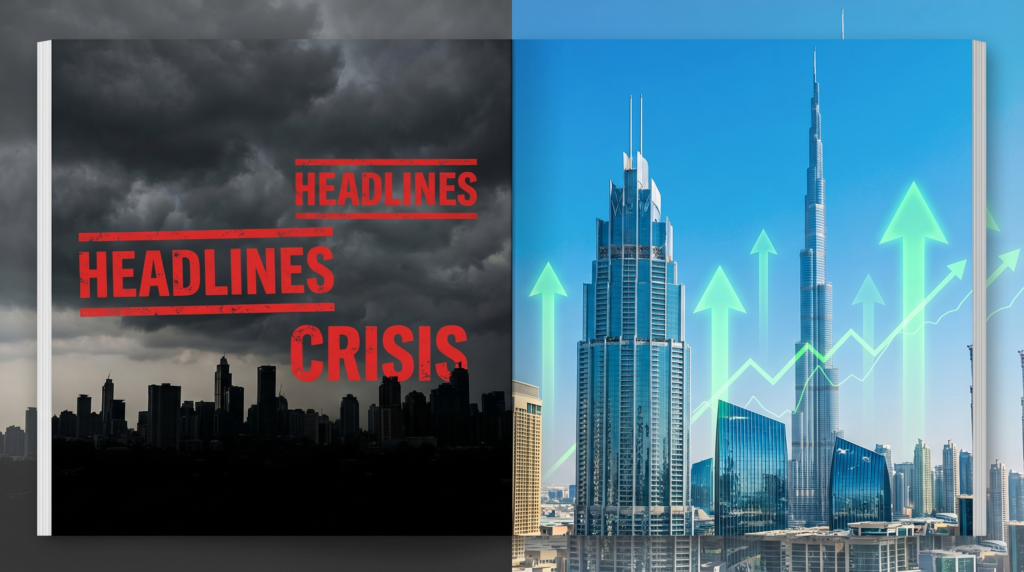
If you’ve been scrolling Instagram recently, you’ve almost certainly seen the post: a dramatic graphic of Dubai’s skyline, bold headlines screaming about “cracks” in the market, Fitch warnings, and a convenient conclusion that investors should pivot to UK property instead.
The post comes from a UK-based property agency that sells UK real estate. They cherry-pick real data points, strip them of context, exaggerate them, and funnel the reader toward purchasing their own product. It is a textbook example of fear-based marketing disguised as market analysis.
As someone who operates across both the Dubai and UK markets, I have a responsibility to give you the full picture. Every market has cycles. Every market faces challenges. But there is a critical difference between honest analysis and weaponising selective data to move your own stock. Let me take each claim and hold it against the actual data.
Myth vs. Fact: Every Claim Checked
Claim 1: “Fitch Ratings warns prices could fall 10–15%”
| CLAIM — MISLEADING Fitch did issue a report in May 2025 forecasting a possible moderate correction of up to 15%. But the post frames this as an inevitable crash. Fitch described it as normal market normalisation after 60% cumulative growth since 2022 — not a collapse. Fitch explicitly stated that prime locations would remain resilient and that UAE banks and developers were well-positioned to absorb any softening. |
| REALITY — WHAT THE DATA SHOWS Residential prices in Dubai grew 13% year-on-year through 2025, extending a growth cycle of 22 consecutive quarters. The market moderated from 22% growth in 2023 to 12% in 2025 — a healthy deceleration, not a crash. As of early April 2026, the actual price softening has been 4–7% from peak, driven primarily by regional geopolitical tensions rather than structural oversupply. |
Claim 2: “210,000 new units flooding the market”
| CLAIM — MISLEADING The headline figure of 210,000 planned units is real, but “planned” and “delivered” are dramatically different things. Between 2022 and 2024, only 97,000 of 174,000 projected units were actually completed — a realisation rate of just 56%. For 2026, approximately 110,500 units are projected on paper, but analysts estimate actual deliveries will range between 33,000 and 50,000 units based on historical patterns. |
| REALITY — WHAT THE DATA SHOWS Dubai’s population surpassed 4 million in mid-2025 — a full year ahead of schedule. Population is growing at 5.5% annually. Approximately 50,000 new business licences were issued in 2025. Nearly 45% of under-construction stock is concentrated in just five districts, and 66% of the pipeline comprises studios and one-bedrooms. Oversupply risk is segment-specific, not market-wide. The villa and townhouse segment remains severely supply-constrained. |
Claim 3: “UBS ranks Dubai among the world’s top bubble-risk cities”
| CLAIM — MISLEADING The post implies Dubai sits at the very top of bubble risk globally. In reality, the UBS Global Real Estate Bubble Index 2025 placed Dubai in the “elevated risk” category with a score of 1.09. Miami scored 1.73, Tokyo 1.59, and Zurich 1.55 — all substantially higher and in the actual “bubble risk” zone. Dubai’s elevated reading reflects rapid growth, not a forecast of collapse. UBS itself noted that Dubai prices remain “comparatively affordable” by global city standards. |
Claim 4: “Q3 2025 transaction values fell 7.6% — investors are trading down”
| CLAIM — MISLEADING Transaction values did dip 6.3% quarter-on-quarter in Q3 2025, but this was driven by a higher proportion of apartment sales — which carry lower ticket prices — not by “investors trading down.” Transaction volumes actually rose 17.1% year-on-year in the same period, with off-plan sales surging 23.6% to a record 42,000 transactions. The market was setting records for activity, not showing structural cracks. |
Claim 5: “Global investors are pivoting back to UK property”
| CLAIM — MISLEADING The data shows the exact opposite. UK buyers were the single largest international buyer group for multiple Dubai brokerages throughout 2025. Leading agencies reported that UK demand strengthened in the second half of the year, driven by unfavourable tax changes in Britain and Dubai’s comparatively predictable regulatory environment. The capital flow has been from the UK to Dubai — not the reverse. The post conveniently omits this because it contradicts the narrative they need to sell their own UK stock. |
AED 1 Billion Government Stimulus: Dubai’s Decisive Response
While social media accounts manufacture fear, Dubai’s leadership is doing what it has always done best: acting with speed, scale, and strategic clarity.
On 30 March 2026, H.H. Sheikh Hamdan bin Mohammed bin Rashid Al Maktoum approved an AED 1 billion economic support package for Dubai’s private sector. Effective from 1 April and rolling out over three to six months, this is a comprehensive stimulus designed to maintain business confidence, protect employment, and keep the economy’s engine running through a period of regional uncertainty.
The context matters: this is not a distress measure. Dubai’s GDP grew 5.4% in 2025, reaching AED 937 billion. Q4 2025 alone recorded 6.4% growth. This is a government acting from a position of economic strength, proactively shielding its private sector.
What the Package Includes
Government fee deferrals. A three-month postponement of selected government administrative, registration, and renewal fees across all sectors — directly improving cash flow for businesses of every size.
Hospitality and tourism relief. Hotels can defer 100% of sales fees and Tourism Dirham charges for three months. With tourism contributing approximately 12% of Dubai’s GDP, this targeted intervention protects one of the emirate’s most vital sectors and the thousands of jobs within it.
Extended customs grace periods. Customs clearance payment deadlines extended from 30 to 90 days, with the possibility of further extensions. This keeps import and export flows healthy and removes short-term financial pressure from trading businesses.
Faster residency processing. Streamlined issuance and renewal of residency permits, making it easier for businesses to attract and retain skilled professionals. This sends a clear signal to global talent: Dubai remains open and committed.
| “Our message is clear: Dubai remains committed to supporting individuals, families and businesses with confidence and stability. With strong institutions and deep community ties, the emirate continues to grow, turning challenges into opportunities and emerging stronger than ever.” — H.H. Sheikh Hamdan bin Mohammed bin Rashid Al Maktoum |
| WHY THIS MATTERS FOR PROPERTY INVESTORS This package works alongside the UAE Central Bank’s Resilience Package, creating a twin fiscal-monetary shield for the economy. For property investors specifically, the implications are significant: developer solvency is supported, construction timelines are protected, rental demand from employed tenants remains intact, and the economy’s underlying engine — the private sector — keeps running.This is the kind of institutional response that separates Dubai from speculative, sentiment-driven markets. It is governance by action, not by hope. |
The Market Fundamentals That Fear-Mongers Ignore
Every crisis Dubai has faced — the 2008 global financial crash, the 2014–2019 market correction, the COVID-19 pandemic — has been followed by a recovery that surpassed the previous peak. The fundamentals driving this city’s property market are structural, not speculative.
Population growth. Dubai hit 4 million residents in mid-2025, a year ahead of the government’s own target. With 50,000 new business licences issued in 2025 alone and the Dubai 2040 Urban Master Plan targeting 5.8 million residents, housing demand is real, measurable, and growing.
Record transaction activity. Over 200,000 residential sales transactions were recorded in 2025, with total values exceeding AED 541 billion — both all-time records. This is not a market running on speculation. It is a market running on volume, depth, and diversified global demand.
Villa market resilience. Only 15,284 villas are scheduled for delivery in 2026 compared with approximately 100,000 apartments. The family-housing segment — the most relevant to end-users — remains severely supply-constrained. Villa prices have more than doubled since 2020 and continue to outperform, with prime communities recording 10–20% year-on-year appreciation.
Cash buyer dominance. Approximately 86% of Dubai property transactions are cash purchases. This insulates the market from interest rate shocks and credit squeezes — a structural advantage over debt-heavy markets like the UK, where mortgage dependency creates systemic vulnerability.Historical delivery gaps. Dubai consistently delivers fewer units than projected. In Q3 2025, only 9,400 units were handed over against projections of 22,800 — a materialisation rate of 41%. The feared “supply tsunami” has always been substantially smaller than the headlines suggest.
Dubai vs. UK: The Investment Comparison
The viral post suggests that investors should “pivot back” to UK property for “legal stability, capital growth and steady yields.” Let’s test that claim against the actual numbers.
| Factor | Dubai | United Kingdom |
| Rental Yields | 6–8% gross average | 4–5% in prime areas |
| Income Tax on Rental | 0% | 20–45% |
| Capital Gains Tax | 0% | 18–28% |
| Annual Property Tax | None | £1,200–£4,000+ council tax |
| Stamp Duty at Purchase | 4% DLD fee | Up to 12% |
| Price Growth 2022–2025 | ~60% | London ~1–3% p.a. |
| Net Yield After Tax | 6–8% (equals gross) | ~2.5–4% |
| Residency Benefit | Golden Visa (AED 2M+) | None |
| Regulatory Direction | Pro-investor; stimulus | Tightening; Renters’ Rights Act |
| THE NET YIELD REALITY When UK agents quote “steady yields,” they are quoting gross. After income tax at 20–45%, capital gains tax up to 28%, council tax, stamp duty surcharges on additional properties, and rising compliance costs from the Renters’ Rights Act, the actual return to a UK landlord is often half the headline figure.In Dubai, the gross yield is your net yield. Zero income tax. Zero capital gains tax. Zero annual property tax. That is not a marginal advantage — it is a structural one that compounds dramatically over a 10–20 year hold. On a £500,000 property earning 7% gross, the UK investor might net £20,000 per year after tax. The Dubai investor keeps the full £35,000. Over ten years, that difference alone exceeds £150,000. |
The UK regulatory environment is also moving against landlords. The Renters’ Rights Act creates new uncertainty, compliance costs are climbing, and many landlords are exiting the market entirely. Meanwhile, Dubai is actively deploying AED 1 billion in business stimulus, streamlining residency permits, and extending customs grace periods to support economic momentum. The direction of travel in each market could not be more different.
Why Dubai Still Wins for Family Living
The investment case is compelling on its own. But the viral post completely ignores the reason so many families — particularly from the UK — are choosing Dubai as their permanent home. This is not just about returns on a spreadsheet. It is about quality of life, day in, day out.
Safety and Environment
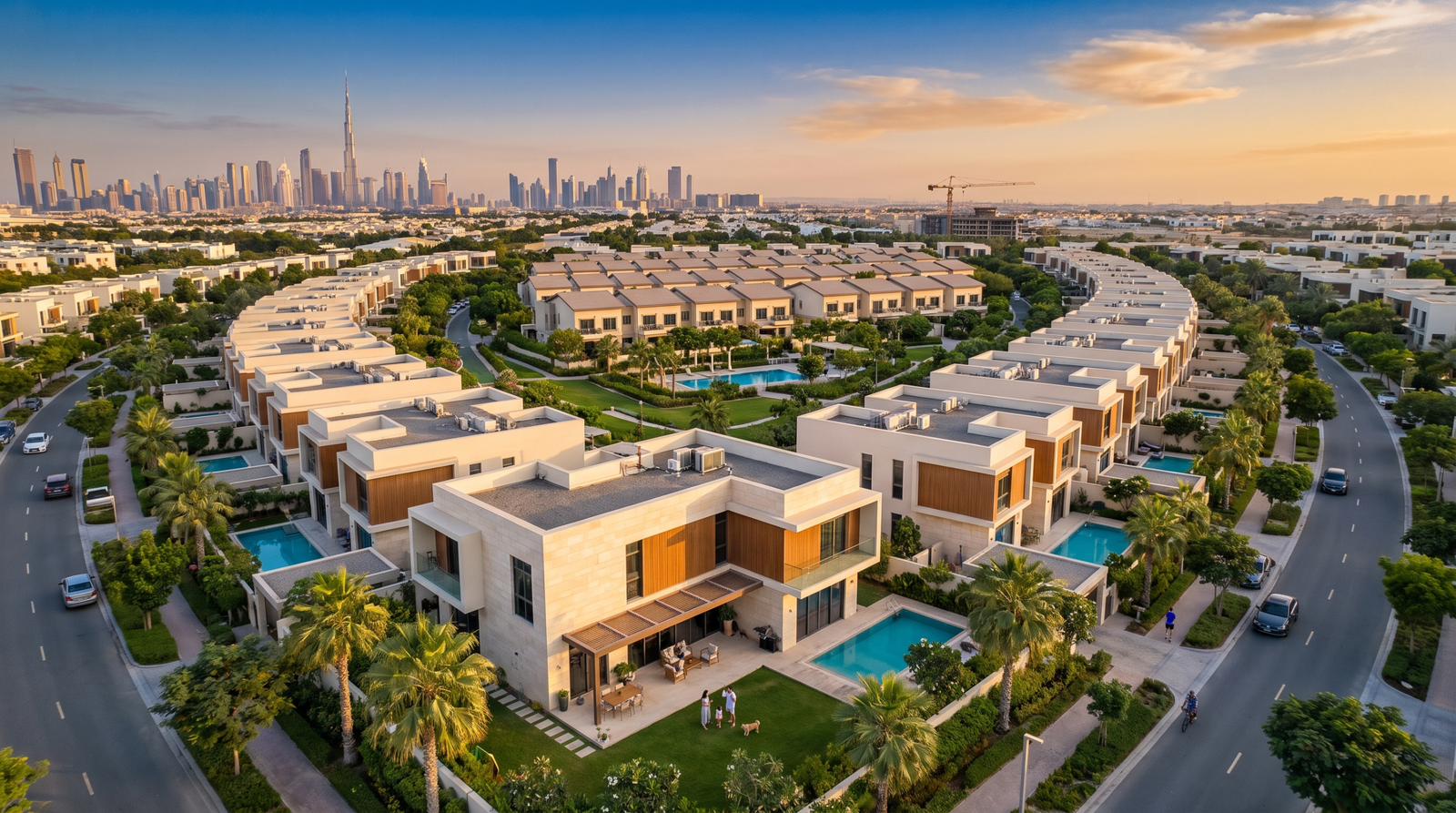
Dubai is consistently ranked among the safest cities in the world. Families enjoy a clean, modern, purpose-built urban environment with world-class infrastructure. Community living in areas like Arabian Ranches, Dubai Hills Estate, and Mirdif offers green parks, cycling tracks, children’s play areas, and gated security that most UK cities simply cannot match. The difference in daily quality of life is not subtle — it is transformative.
Education
Dubai offers over 215 private schools spanning 17 different curricula: British, American, IB, Indian, French, German, and more. The Knowledge and Human Development Authority (KHDA) regulates quality rigorously through annual inspections and public ratings. School enrolments grew 6% in 2025, reflecting the depth of long-term family settlement. For families, this breadth of choice — combined with the ability to select the exact educational philosophy that suits your child — surpasses virtually any city in the world.

Healthcare
Dubai’s private healthcare system is modern, accessible, and family-friendly. Health insurance is mandatory and typically employer-provided, giving families fast access to specialist care without the months-long waiting lists that characterise the UK’s overstretched National Health Service. For families with young children especially, the speed and quality of healthcare access in Dubai is a significant practical advantage.
Lifestyle and Living Space
Dubai offers substantially more living space for less cost than London or other major UK cities. A family that might afford a two-bedroom flat in an outer London borough can access a three or four-bedroom villa with a private garden, community pool, and modern amenities in Dubai. Add year-round sunshine, public beaches, world-class entertainment, and a multicultural community of more than 200 nationalities, and the lifestyle case speaks for itself.
Financial Freedom
With zero personal income tax, families keep 100% of what they earn. A household with £150,000 of gross income in the UK might take home approximately £100,000 after income tax and National Insurance contributions. The same household in Dubai keeps the entire amount. Over a decade, that cumulative difference alone — potentially £500,000 or more — can fund children’s education, build a property portfolio, or secure a retirement that would be impossible on UK net salaries.
The Verdict
Let me be direct about what is happening. Dubai is navigating a genuinely challenging moment, driven by regional geopolitical tensions that no one predicted and no one controls. Property prices have softened 4–7% from their peak. That is real, and I will not pretend otherwise.
But this is a geopolitical event, not a structural market failure. The fundamentals have not changed. Population is growing. Transaction volumes remain at historically exceptional levels. Supply is being absorbed. The regulatory environment continues to favour investors. And the government has responded with a decisive AED 1 billion stimulus package within weeks of the disruption — the kind of institutional agility that sets Dubai apart from almost any other property market on earth.
The tax advantages over the UK are not marginal — they are transformative over a long-term hold. For families, the combination of safety, world-class education, modern healthcare, generous living space, and complete financial freedom makes Dubai one of the most compelling places in the world to live and invest.
Fear sells on social media. Data tells a different story. The investors who built generational wealth in Dubai did so by looking past the headlines, understanding the fundamentals, and recognising that periods of uncertainty are precisely when the best opportunities present themselves.
| “Dubai has earned a reputation for credibility, transparency, and trust among businesses and investors worldwide, and stands ready to meet any challenge through the determination of its people and the strength of its inclusive society.” — Dubai Executive Council Statement, 30 March 2026 |
Book Your Free Dubai Property Strategy Call
Whether you are a first-time Dubai investor, a UK-based family considering relocation, or an experienced portfolio holder looking to rebalance, book your free strategy call today and I will give you a clear, data-driven strategy tailored to your specific goals, budget, and timeline.