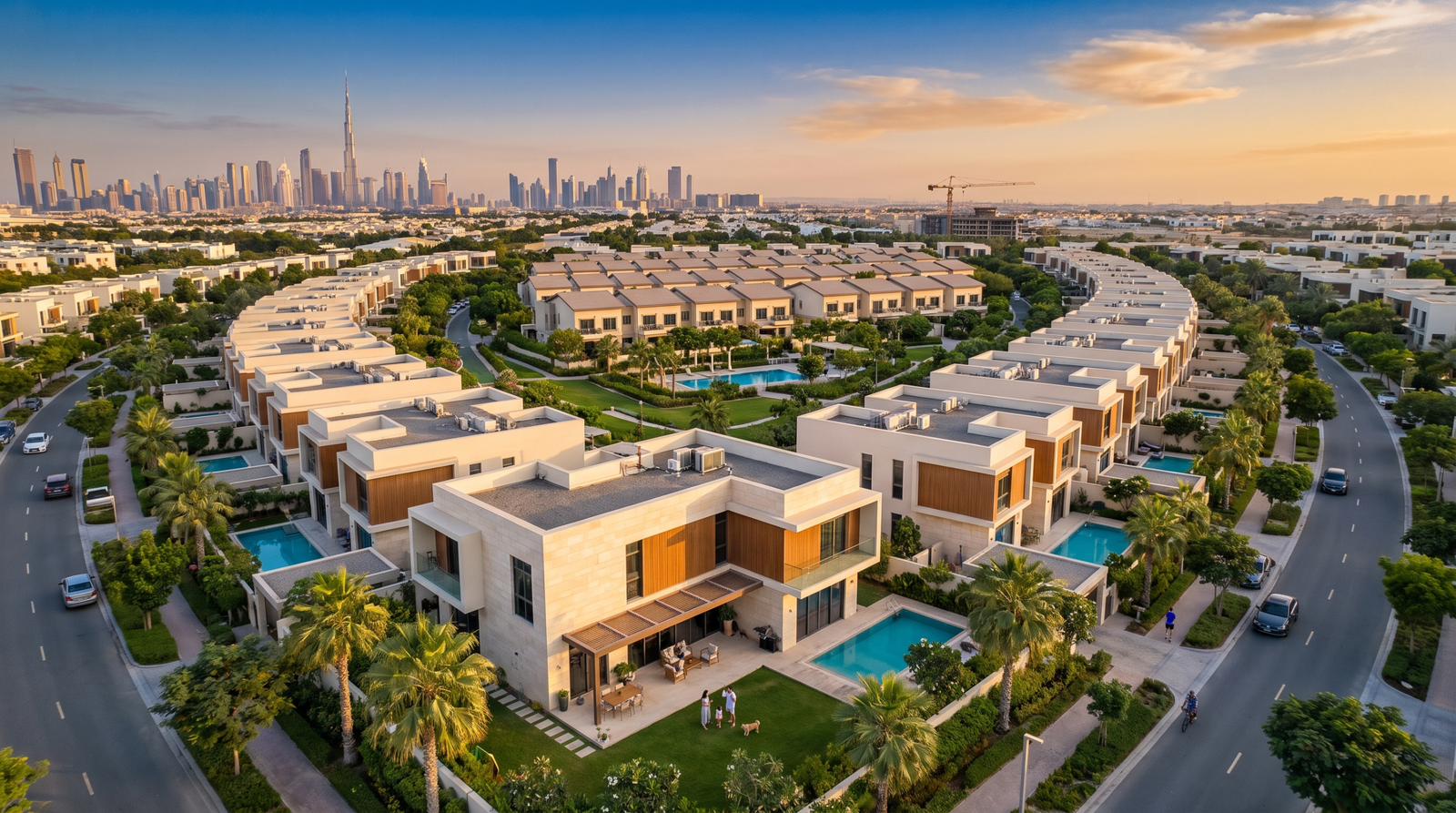
Dubai’s real estate market just crossed AED 252 billion in transactions in Q1 2026 alone — a 31% jump on the same period last year — with 60,303 deals processed in three months. April and May added roughly 33,000 more transactions worth AED 84.7 billion, tracking 6% above the same period in 2025.
But underneath that headline number, something else is happening. More than 2,800 owners have slashed prices, with discounts running from 10% to 50% on distressed listings. Off-plan investors who bet on the rally continuing are getting squeezed by payment plans. And the gap between a real Dubai broker and what local agents privately call a “shawarma agent” has never mattered more.
If you’re buying property in Dubai in 2026 — your first apartment, your fifth investment unit, or an off-plan villa you plan to live in — the broker you pick will quietly determine whether you build wealth or burn capital. This guide breaks down how to tell the difference, using the same buyer-protection framework I use with my own clients on the J2 Hub podcast.
What Is a ‘Shawarma Agent’?
“Shawarma agent” is Dubai broker slang for the operator who treats real estate like a fast-food transaction: take the order, hand over the goods, walk away. They’re loud on TikTok, light on track record, and they tend to dissolve the moment paperwork gets complicated.
I’ve used the phrase publicly on the J2 Hub podcast and the response has been almost universal — every serious broker in this city has met one. The market is full of them. They survived the last cycle because the cycle was good: when everything appreciates 20% a year, even a bad broker looks lucky. That era has ended.
What follows is the working definition: a shawarma agent is a broker whose value proposition collapses the moment the market stops doing the work for them.
Why 2026 Is the Year Broker Quality Decides Your Returns
Three structural shifts in the last 18 months have made broker selection more consequential than at any point since 2008.
1. The market is splitting in two
Villa and townhouse prices are still climbing 12–18% year-on-year. Mid-market apartments are pacing 5–10%. But emerging neighbourhoods — particularly off-plan stock in JVC, Business Bay, and Dubai South — are showing the deepest stress, with more than 500 price drops recorded in a single week. A broker who steers you toward the wrong inventory at the wrong cycle point can cost you years.
2. Off-plan exposure is now risk-weighted
Off-plan accounted for 57% of residential transactions by volume in Q1 2026, but ready properties commanded 62% of total value. Brokers who pushed clients into multiple off-plan units betting on “flip before handover” now have clients absorbing margin calls from payment plans. A real broker tells you when not to buy. A shawarma agent tells you what closes their commission.
3. The regulator is finally biting
In H1 2024, the DLD’s Real Estate Control Department ran 450 field inspections, completed 1,530 advertisement audits, and fined 256 brokers for non-compliance. That enforcement cadence has accelerated through 2025 and 2026, sitting alongside the Smart Rental Index (building-level rental benchmarking) and tighter Madmoun ad permitting. Working with an unverified broker is now a legal and financial risk, not just a customer-service one.
The takeaway: in a flat or correcting market the broker stops being a search engine and becomes a financial advisor. The wrong choice locks you into the wrong product at the wrong cycle point.
6 Red Flags of a Shawarma Agent
After almost a decade brokering in Dubai, here are the six patterns that consistently identify the wrong kind of operator. See more than two of them in one meeting and you should walk.
- They start selling in the first five minutes. Real brokers present. Shawarma agents pitch. If the first half-hour with someone is them telling you what to buy instead of asking what you actually need, you’re being sold to, not advised. My own rule with clients: my job is to present the options. Their job is to sell it to themselves. I’m only there to give the final nudge if they need one.
- They can’t produce a track record. Ask for the last five transactions they personally closed — buildings, developers, payment plans. A real broker will rattle them off. A shawarma agent will get vague, change the subject, or pivot to their “team.” Dubai has thousands of RERA-licensed brokerages and tens of thousands of active broker cards in circulation — track record is the only meaningful differentiator.
- They won’t walk you off a bad deal. Bring up a unit you’ve already shortlisted that has obvious weaknesses — wrong floor, weak payment plan, distressed developer. A real broker tells you flat-out it’s not the move. A shawarma agent helps you justify it because their commission depends on you transacting.
- The W column is empty and the L column is full. Run the W vs L test (see worksheet below). Take the deal in front of you and list the wins and losses honestly — developer, building, payment plan, equity release potential, holding cost, exit liquidity. If the broker can’t show you more wins than losses on paper, they shouldn’t be recommending the deal and you shouldn’t be considering it.
- They go quiet after the offer is accepted. A real broker treats handover as the beginning of the relationship, not the end. If their communication drops between SPA signature and key collection, you’ll be on your own for snagging, mortgage drawdown, rental management, and resale years from now. I tell my own clients explicitly: “This isn’t a one-night stand. We’re married now. You can’t get rid of me.”
They’ve pivoted from selling property to selling courses. Watch for the broker who’s quietly transitioned from closing deals to running paid “masterclasses” for newer agents. Pull their actual transaction history. The ones running this play in 2026 often haven’t closed a personal deal in 12–18 months — they’re monetising other agents because the market stopped monetising them.

What a Real Broker Actually Does Differently
Three behaviours separate real Dubai brokers from the shawarma category. Interview for them explicitly.
They use the W vs L method, openly
When I sit with a buyer, I draw two columns: wins and losses. Everything about the deal goes in one column or the other. Tier-1 developer = W. Beachfront frontage = W. Two-year hold to handover = W. Equity release at completion = W. Short-term 10% correction risk = L. Holding cost during build = L. By the time the conversation is over, the client can see the maths themselves. There’s no closing pressure because there doesn’t need to be — the wins are visible.
They treat the relationship like a marriage, not a one-night stand
A real broker holds your hand on snagging, mortgage drawdown, resale prep, and tenant management for years after the deal closes. I told one client recently — a high-profile sports professional who spent six hours with me before buying — “When you work with me, we’re married. I put a ring on it.” Two years on, he’s still on the phone whenever something comes up, and his referrals have brought in another four families. That’s what compounding looks like.
They understand the expertise gap
Clients come to you because you have skills they don’t. If they had the skills, they’d be the broker. The doctor analogy applies — when something is wrong with your body, you don’t go to a YouTube tutorial, you go to a doctor. The broker who treats the client like a peer they need to impress is making the wrong trade. Respect the client. Don’t subordinate to them. The relationship works when the broker holds the expertise and the client holds the decision.
How to Verify a Dubai Broker in 60 Seconds
Dubai’s regulator has made broker verification easier than almost any market in the world. Run this checklist before you take a second meeting.
- Trakheesi check. Every legitimate broker holds a RERA-issued Brokerage Practice Card with a unique number. Look them up via DLD’s Trakheesi system on dubailand.gov.ae or the Dubai REST app. You should see active status, the brokerage they’re attached to, and their classification level.
- Madmoun QR scan. Every legal property advertisement in Dubai now carries a Madmoun permit number and QR code. Scan it. If the listing doesn’t have one, the broker is advertising illegally — and that tells you everything you need to know.
- Brokerage office license. RERA licenses brokerages, not just individuals. Look up the office license on the DLD’s licensed broker registry. A broker tied to a brokerage that’s been disciplined or de-listed is a broker to avoid.
- CEU compliance. RERA cards expire every 12 months and require 8–16 hours of Continuing Education Units to renew, with renewal fees running AED 2,500–4,500 depending on education level. Ask when their last renewal was. A broker drifting out of compliance is a broker drifting out of the industry.
If any of these come back blank, ambiguous, or contested — the broker has effectively self-identified.
Got a question or ready to talk through a deal? Message James directly on WhatsApp. Talk to James on WhatsApp →

The 7 Questions to Ask Before You Sign Exclusivity
Take these into your next broker meeting. The answers will tell you everything inside 20 minutes.
- Can you walk me through the last five transactions you personally closed — developer, building, payment plan, and outcome?
- What’s your view on the off-plan correction in JVC, Business Bay, and Dubai South right now?
- Show me a deal you talked a client out of in the last six months. What were the L’s that killed it?
- What percentage of your buyers come from repeat business or referrals (not portals or cold calling)?
- What’s your service model after handover — snagging, financing, resale prep, tenant management?
- What’s your RERA card number, and which brokerage are you licensed under?
- If I show you a brochure cold — Address, Oasis, Heights — can you tell me without checking what the developer’s last three handovers have actually resold for?
If the broker can’t comfortably answer five out of seven, they’re either too junior or they’re a shawarma agent. Either way, keep looking.
The W vs L Worksheet
Print this. Run any deal a broker brings you through both columns before you sign anything. If your broker won’t fill it out with you, that itself is the answer.
| WINS (W) | LOSSES (L) |
| Tier-1 developer (Emaar, Nakheel, Sobha, Damac Maison-grade) | Untested or distressed developer |
| Building in active resale community with proven liquidity | Emerging cluster with thin transaction history |
| Payment plan that protects you (escrow, milestone-linked) | Front-loaded payment plan with weak DLD oversight |
| Equity release potential at handover | No realistic exit before completion |
| Service charges aligned with comparable buildings | Service charges significantly above area average |
| Rental yield supports holding cost | Negative carry with no clear catalyst |
| Broker stays in the relationship post-handover | Broker drops contact after SPA signature |
| Independent verification (Trakheesi + Madmoun) passes | Listing or broker fails RERA verification |
Decision rule: if the W column does not visibly outweigh the L column on paper, walk — regardless of how good the pitch sounded.
The Bottom Line
Dubai’s market in 2026 is not the market that made people rich in 2022. It’s wider, deeper, more regulated, and more punishing of mistakes. Q1 2026’s AED 252 billion in transactions hides a softer secondary market, off-plan distress in emerging clusters, and a quietly accelerating regulatory crackdown.
The buyers who do well from here will be the ones who pick brokers who can read the cycle, walk them off bad deals, and stay in the relationship long after handover. Ask the seven questions. Run the Trakheesi check. Fill out the W vs L worksheet. If your broker won’t do this with you, find one who will.
How do I verify a real estate broker in Dubai?
Search the broker’s name and card number on DLD’s Trakheesi system at dubailand.gov.ae or in the Dubai REST app. You should see active RERA status, the brokerage they’re attached to, and their classification. Also scan the Madmoun QR code on any listing they show you — every legal Dubai property ad carries one.
What is a RERA broker card?
A RERA Brokerage Practice Card is the official license issued by Dubai’s Real Estate Regulatory Agency that allows an individual to broker property transactions. It requires a 4-day (32-hour) CTREB training course, a 100-question exam with a 70% pass threshold, and renewal every 12 months through 8–16 hours of Continuing Education Units. Total setup cost is roughly AED 10,000–13,000.
Are Dubai real estate brokers regulated?
Yes. Brokers are licensed by RERA under the Dubai Land Department. The DLD’s Real Estate Control Department runs active enforcement — in H1 2024 alone it conducted 450 field inspections, audited 1,530 advertisements, and fined 256 brokers for non-compliance. Working with an unlicensed broker is a legal risk.
What’s the difference between an off-plan and a secondary market broker in 2026?
Both should hold the same RERA license, but the skill sets diverge. Off-plan brokers need fluency in payment plans, escrow protections (Law No. 8 of 2007), developer track record, and handover timelines. Secondary market brokers need pricing intelligence, snagging knowledge, mortgage workflows, and exit-liquidity data. A real broker tells you which side of the market suits your situation — a shawarma agent pushes you to whichever pays the higher commission.
How long does it take to sell property in Dubai right now?
Well-priced apartments in active communities are selling in 30–60 days. Villas and larger properties take 60–120 days. Apartments make up over 80% of all sales by volume. The buyer pool is real — 68% of active property seekers plan to purchase within six months — but the secondary market is more price-sensitive than it was 18 months ago.
Ready to Run the W vs L Test on Your Next Deal?
Book a 30-minute no-pitch consultation. Bring the deal you’re looking at, and we’ll fill in the wins and losses together — whether you end up working with us or not.
Ready to Run the W vs L Test on Your Next Deal?
Book a 30-minute no-pitch consultation. Bring the deal you’re looking at, and we’ll fill in the wins and losses together — whether you end up working with us or not.