
In March 2026, the National Health Service reached a milestone it had been chasing for years. The waiting list for elective treatment in England fell to 7.11 million cases, the lowest figure in more than three years. NHS England called it a “huge moment.” Two months later, the same waiting list had climbed back up to 7.31 million.
For roughly 6 million individual patients now caught inside that backlog, the headline progress means very little. Some are waiting for hip replacements. Some are waiting for a consultant to confirm a cancer diagnosis. Around 94,000 of them have been waiting for more than a year.
Meanwhile, 5,500 kilometres away in Dubai, a private specialist appointment can usually be booked for tomorrow.
This is not a story about which healthcare system is morally superior. It is a story about access — and why a growing number of British patients, expats, and even returning visitors are now choosing to be treated abroad.
| KEY STAT · As of May 2026, the NHS elective waiting list stands at 7.31 million cases. Approximately 2.47 million patients have waited longer than the 18-week target, and around 94,000 have waited more than a full year. (Source: NHS England RTT data, March 2026.) |
1. The NHS in May 2026: progress, but not enough
To be fair to the NHS, the trend line has shifted. Between July 2024 and March 2026, the waiting list shrank by 515,000 cases — the biggest sustained reduction since the pandemic. More than half a million additional patients started or completed treatment compared with the previous year. The 18-week referral-to-treatment standard is finally being met for 65.3% of patients (the target is 92%).
But the underlying numbers tell a different story for anyone actually waiting:
- 7.31 million open cases on the elective waiting list (May 2026)
- 2.47 million patients have already waited longer than 18 weeks
- 94,000 patients have waited more than 12 months
- Median wait to start treatment: 11.3 weeks — up from 6.9 weeks pre-COVID
- Only 72.8% of suspected cancer cases get a diagnosis within 28 days (target: 75%)
- Only 68.4% of cancer patients start treatment within 62 days (target: 85%)
Put plainly: if you are referred today for a non-urgent procedure in England, your statistically expected wait is just under three months before treatment begins. If you are referred for something more complex, it can be six months, a year, or longer.
2. The Dubai alternative: speed first, paperwork later
Dubai operates a hybrid public–private healthcare system regulated by the Dubai Health Authority (DHA). Residents are required by law to hold valid health insurance — a rule introduced in 2014 and tightened further at the start of 2025 to include domestic workers and dependants.
The infrastructure is dense. As of 2026, the emirate counts more than 3,700 licensed clinics and over 30 hospitals serving a population of around 3.8 million. By comparison, England has around 215 acute NHS hospitals serving 56 million people.
For patients, the practical difference is felt in two places: speed and choice.
Wait times
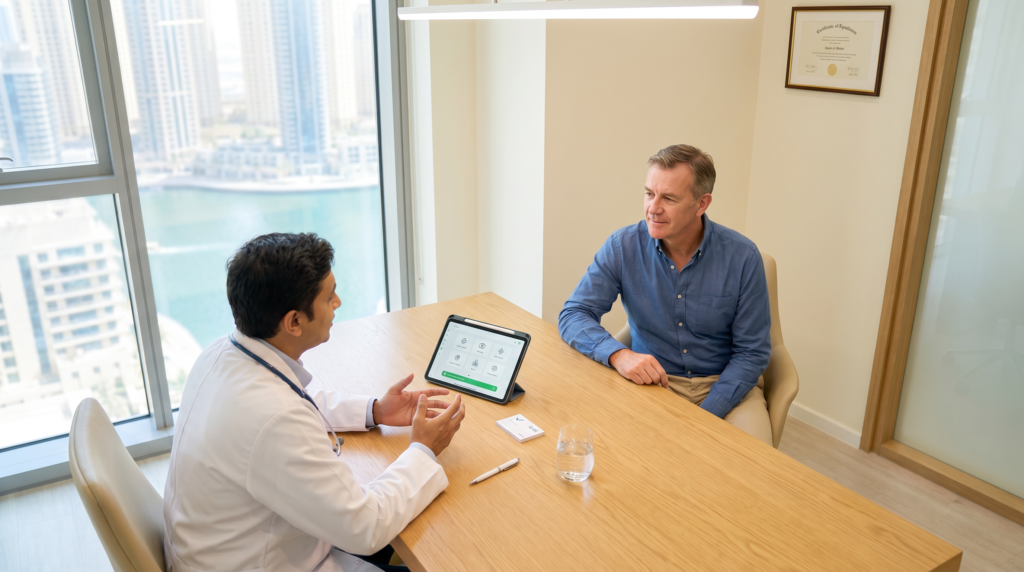
Dubai’s private facilities routinely offer same-day or next-day specialist appointments. A consultant cardiology booking that might require a 14–18 week NHS wait is typically available within 48 hours in Dubai Marina or Jumeirah. MRI and CT scans, often a six-week NHS bottleneck, are scheduled within 24–72 hours.
Cost (when paying out of pocket)
Consultations in DHA-licensed clinics typically cost AED 300–400 (roughly £65–£85), with public facilities offering the same service for AED 100–200. Private hospital procedures vary widely, but the system is built around insurance, not direct billing, and the vast majority of residents never pay these prices directly.
Side-by-side: NHS vs Dubai healthcare access, 2026
| Measure | UK / NHS (May 2026) | Dubai (May 2026) |
|---|---|---|
| Elective waiting list | 7.31 million cases | None — bookings on demand |
| Specialist appointment wait | 11.3 weeks (median) | Same-day to 48 hours |
| Cancer treatment in 62 days | 68.4% (target 85%) | Typically 7–14 days |
| Hospitals per million people | ~3.8 | ~7.9 |
| Mandatory insurance | No (NHS funded via taxation) | Yes — from AED 320/year |
| Cost per consultation (out of pocket) | Free at point of use | AED 100–400 (£22–£85) |
3. What it actually costs to get covered in Dubai
The biggest misconception about Dubai healthcare is that it is reserved for the wealthy. In practice, mandatory basic plans for low-income workers start at AED 320–550 per year (roughly £67–£115). At the other end of the spectrum, premium expat plans with international coverage can reach AED 20,000+ per year.
Most working professionals fall somewhere in the middle, and insurance is typically provided by the employer as part of the work visa package.
Typical 2026 monthly premium ranges
| Plan tier | Monthly premium (AED) |
|---|---|
| Essential Benefits Plan (DHA mandatory minimum) | AED 50–150 (≈ £11–£32) |
| Standard expat plan (Daman, Sukoon, Orient) | AED 550–2,800 (≈ £115–£590) |
| Bupa Global / international plan | AED 950–3,500 (≈ £200–£740) |
| Premium VIP plan (worldwide, evacuation, dental) | AED 3,500–6,000+ (≈ £740–£1,260+) |
UAE health insurance premiums increased by an average of 11.5% in the 2026 renewal cycle, driven by rising medical costs and broader coverage requirements. Even after this hike, the median family of four in Dubai pays around AED 18,000–25,000 per year for comprehensive private cover — significantly less than equivalent private medical insurance in the UK, where Bupa or Vitality family plans now average £2,800–£4,500 per year and still rely on the NHS for emergencies.
4. Why British patients are now travelling for treatment
Medical tourism from the UK to the UAE was a fringe phenomenon a decade ago. In 2026, it is mainstream enough that several Dubai hospitals — including Mediclinic, King’s College Hospital London Dubai, and Saudi German Hospital — now publish dedicated UK patient packages.
Three drivers are pushing the trend:
- Wait time arbitrage. A privately-funded hip replacement that costs £14,000–£18,000 in the UK can be performed in Dubai for £8,000–£11,000 — including flights, hotel, and post-op physio.
- Surgeon availability. Many UK consultants now hold visiting privileges in Dubai. British patients can sometimes see the same surgeon they would in London, sooner, at a lower price.
- Expat infrastructure. The 240,000 British nationals living in the UAE have built a network of GP referrals, follow-up clinics, and English-speaking specialists that makes the experience familiar.
| KEY STAT · In 2026, a 65-year-old patient referred for a non-urgent knee replacement in England has a statistical 50% chance of starting treatment within 11.3 weeks. The same procedure in Dubai is typically scheduled within 5 to 10 days of consultation. |

5. The honest trade-offs
Dubai’s healthcare offer is not perfect, and a fair comparison requires naming the gaps.
The NHS remains free at the point of use, covers everyone in the country regardless of employment, and excels at complex emergency care, organ transplants, and rare-disease specialisms. For chronic, lifetime, multi-system conditions — where ongoing free care matters more than speed of access — the NHS still represents one of the strongest healthcare propositions in the world.
Dubai’s system, by contrast, is built for residents and visitors who can pay (directly or via insurance), and quality varies between facilities. Mental health services, while improving rapidly, are less developed than in the UK. And anyone considering treatment abroad should still consult their UK GP about continuity of care before they fly.
6. Dubai 2026 Guide
Free healthcare means very little when 6 million people are waiting in a queue. The NHS is improving — the data confirms it — but for patients who cannot afford to wait three months for a scan, a year for a procedure, or 62 days for cancer treatment, the question has shifted from “NHS or private?” to “NHS or somewhere else entirely?”
In May 2026, Dubai is increasingly the somewhere else.
Whether the answer is full relocation, an annual private plan, or a single procedure booked between flights, the maths is hard to argue with: same condition, same surgeon in many cases, a fraction of the wait.
Thinking about moving to Dubai?
Get our free 2026 Dubai relocation guide — covering visa routes, the best health insurance plans for British expats, property options, and step-by-step costs. Sent straight to your inbox.